Thursday, May 21, 2026

[dVerse] May 19th - This Is Not a Walk

This Is Not a Walk
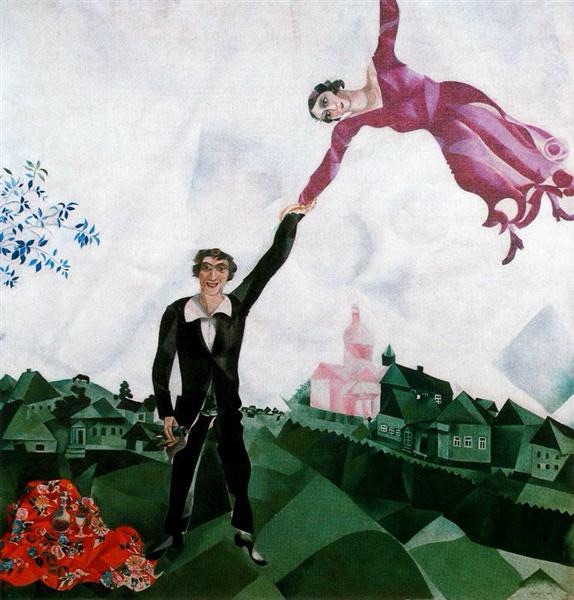
after Chagall’s La promenade

Marc Chagall, La promenade (The Promenade) (1918), oil on canvas

This is not a woman flying.
This is not a man holding the wrist of his weather.
This is not love,
though love is often accused of such public misconduct.

The green beneath them is not a field.
It is not obedience pretending to be grass.
It is not the ancestral courtyard where daughters learn how low the sky can be.

The houses are not houses.
They are not witnesses with their windows buttoned shut.
They are not relatives leaning out to ask where she is going
in that dress,
with that body,
with that much altitude.

The bouquet is not a bouquet.
It is not apology.
It is not proof that romance has completed its paperwork.

The small red church is not a church.
It is not permission.
It is not the office where joy must apply
for a identity certificate,
salary slip, father’s signature,
and two passport-size photographs.

And he—the man on the ground—
is not a saviour.

Let us be clear.

He is not gravity.
He is not ownership.
He is not the nail holding her blue hem to the village map.

He is only a hand still surprised to be trusted.

She is not escaping.
She is not performing lightness for the museum wall.

She is what happens when the body remembers
it was never a cupboard,
never a locked room,
never the careful daughter
folded into the good bedsheet.

Above them, the sky
is not blue.
It is not sky.
It is a loophole.

And the air—that shameless clerk—
has misplaced every form
that once required her
to stay.

~ Oizys.

Written for dVerse Don’t box me in: Chagall by Melissa Lemay on May 19, 2026.

Tuesday, May 19, 2026

[dVerse] May 18th - safety through ugliness

safety through ugliness

the phone cover sheds
its tired skin
while I eat
a sandwich late.
hunger sits beside me,
loyal as a dog,
waiting for the command
to leave.
I say stay.
it stays.
I say live.
it looks away,
like I am asking too much.

~ Oizys.

Word count: 44
Written for dVerse Quadrille #248 – This One’s Gone to the Dogs By whimsygizmo on May 18, 2026.

Monday, May 18, 2026

The stuck-but-not-dead phase is suffocating as hell. The phone cover remains ugly because honesty is expensive.

19th May 2026. 00:35 AM.

today, as i made a sandwich which i was supposed to make on sunday night, but monday night it is, i thought again about the strange violence of delay. not the cinematic kind. not the kind with music swelling in the background and a woman finally throwing open the doors of her house with one suitcase and a jawline sharp enough to cut patriarchy in half. no. the other kind. the kind where you watch thousands of videos on pinterest because the body is hungry but the mind cannot decide what is worth feeding. the kind where you stand in the kitchen with a dizzy head, an empty stomach, and no particular desire to continue life, and still assemble bread, filling, sauce, whatever else the internet convinced you would make the evening survivable. it came out underwhelming. of course it did. what else could it have done? save me?but i sat down and ate it. this is not triumph. please do not clap. i am allergic to inspirational readings of basic survival. sometimes eating is not victory. sometimes eating is just the body filing a complaint against disappearance. while eating, i noticed my phone cover was crumbling down. i did not think much of it at first. it has been breaking for a while. the edges are tired. the back has started giving up. the whole thing looks like it has survived a small domestic war, which, to be fair, it has. i kept using it because it still technically protects the phone. ugly things are useful like that. broken things know how to continue without making a scene. i finished eating. i scrolled pinterest for a while [i have deactivated instagram for some time now, it's been over a week, i believe]. then, for some reason, i had this unfamiliar urge to come and write. unfamiliar, because these days writing does not arrive like a calling. it arrives like a survivor crawling out from under rubble and saying,
unfortunately, i still have notes.  i am tired of this burrowing of tunnel. i am so tired of the idea that escape is something you dig quietly, with bleeding hands, while still showing up to meetings, paying bills, answering messages, cooking underwhelming sandwiches, pretending to have opinions on things that are not directly related to whether you will make it out alive. why do things not end when you stop? why, when you stop fighting for one second, do they not simply collapse out of respect? why do they instead take revenge by becoming heavier? this is the part no one tells you properly. stopping does not stop the machine. exhaustion does not pause consequences. grief does not clear your calendar. burnout does not pay rent. abuse does not say, “oh, she is tired now, let us withdraw our forces.” no. abuse is administrative. it keeps records. it sends reminders. it charges interest.

i am in a stuck-but-not-dead phase. not healed. not liberated. not fully hopeless either. more like: trapped, furious, articulate, dissociative, overworked, under-credited, financially squeezed, emotionally starving, and still annoyingly capable of wanting things. that is the insult, really. that wanting has not died yet. some days i feel like a ruin with appetite. a corpse with preferences. a woman who says she wants to vanish and then spends twenty minutes comparing phone covers online because apparently even despair has aesthetic standards. the sentence “when i leave” as both prayer and threat. when i leave, i will sleep. when i leave, i will buy the things i like without making them explain themselves. when i leave, i will put colour on my objects. when i leave, i will not need ugliness as camouflage. when i leave, i will have a room with a lock, a kitchen with silence, a life where no one converts my breathing into evidence. but there is another fear sitting beside that sentence. the fear is: what if “when i leave” becomes a museum of postponed selfhood? what if i have placed so much of myself in that future room that the present has become only a storage unit? what if i keep embalming my desires for later and later never develops the manners to arrive? the counterforce is: wanting has not died yet. this home of mine is not just family or a mere household. it is court, prison, propaganda machine, archive, surveillance apparatus and you know what happens when you question the state machinery. so, please remember, i am writing from inside a house where abuse, control, noise, secrecy, mother-silence, sister-return, and family mythology have political weight. nothing here is “just personal.” the personal became political long before i learned the slogan. the personal was already political when my body learned which footsteps meant danger, which silences meant punishment, which rooms could be entered and which truths had to be buried alive.
in my “no miracle exit” post, i have made, for you all, the most important argument of the current arc: abuse's job is not only to hurt you; but it's job is also to steal the labour needed to leave. this is why people stay. not because they love pain. not because they lack self-respect. not because they are stupid, weak, dramatic, dependent, confused, addicted to suffering, or whatever else people say from the safety of distance. people stay because leaving requires the very resources abuse has been eating for years. money. sleep. clarity. documents. confidence. time. privacy. a nervous system that can complete a task without setting itself on fire. then, my work is just the office-version of domestic exploitation, the same old script wearing office clothes: invisible labour, stolen credit, last-minute urgency, junior-woman infrastructure, “just this once” becoming a whole economy of extraction. the family teaches you to become useful without becoming visible. the workplace simply monetises the training. and somewhere in the middle of this, i am supposed to have hope. haha, don't worry, it's pathetic and i have it. and, my hope is not clean. i clearly hate motivational hope, and rightly so; it would sound obscene in this archive. my hope is more like: leaving a message unread, drinking water after punishing the body, wanting pizza. wanting sea air. wanting a room with a lock. wanting one morning where no one’s mood enters my bloodstream before breakfast. writing the ugly sentence. keeping the tab open. not vanishing. and then there is fiction.

since my last post on 15th may, i have kept my lidia poët/pierluigi fixation alive, like one keeps a candle alive during a power cut. not because the candle is enough, but because darkness is rude and someone must resist it. it is not “just fangirling.” i resent that phrase sometimes. “just fangirling” is what people say when they want to make women’s intense readings of desire sound unserious. as if the whole history of literature is not men staring at women and calling it philosophy. this fixation is proof that i am still alive—shamefully, unfortunately—enough to be moved. but it is also a cruel mirror of what my actual life does not contain: recognition, charged presence, softness, risk, being wanted without being interrogated. fiction rescues me, then invoices me. brutal. accurate.

i keep thinking about lidia and pierluigi. how he is never simply a romantic possibility; he is also a test of the world’s conditions. can a woman be loved without being absorbed? can she be desired without being domesticated? can she be held without being converted into wife, mother, symbol, property, compromise? lidia’s freedom and liberty has to remain unconditional. inevitable. non-negotiable. that is the centre. that must always be the centre. always. and still, because i am human and therefore embarrassing, i think about the scene in season 3, episode 1. i think about the way she called him her young werther. i think about the surgery. about him saying he would not have had it without her. what a heavy weight of love. to choose to live because someone made life desirable again. to let another person become the thin bridge between your body and its own continuation. i think of that earlier moment too, in previous season's episode, when after she helped him with the injection, he told her, sad-flirty, to remove the ribbon from her neck. and when she asked whether he hated it, he said no. it would give him the desire to live again. ridiculous man. devastating line. and then he does live. for her? because of her? beside the idea of her? who knows. fiction is clever. it gives you enough evidence to ruin your week and not enough evidence to win in court. the writers put her with jacopo in the end, “unhappily in love,” and of course i understand the logic. fourneau proposed marriage, and from the beginning it was clear that lidia was not a woman of marriage, family, children. jacopo made that mistake once and learned. but as any desperate shipper who ships a ship destined to sink knows, we like asking useless questions. why could fourneau and lidia not be “unhappily in love” together? yes, yes, i know. there was risk. there was blackmail. there was reputation, law, violence, exposure. there was always the threat of being caught and compromised again. pierluigi himself was blackmailed. their intimacy was not happening in a private world. it was happening in a world where a woman’s desire could be turned into a public document by morning. maybe that is why their soft subtextual interactions in the last season hit harder. desire under surveillance has a special voltage. “after today nobody will think we ever liked each other.” that line has been following me around. he says he cannot do anything less than maximum penalty. she asks, “you can’t or you won’t?” and then he half-smiles, softly, terribly, and wishes her luck, which she returns too. and then there is that ultra-misogynistic tirade. god. that performance of public cruelty. that convenient masculine mask. probably because he was blackmailed by the judge. maybe strategic, maybe necessary, maybe not, but still ugly. still something that has to be said in the language of the enemy. still proof that even when a man helps, the structure often asks him to borrow its mouth. after the verdict, he gives her that small nod, that small smile, while lidia, surrounded by her people, joyfully screams in and for her own liberty, and every woman’s liberty. and maybe that is the correct ending. not romance, but liberty. but i also keep thinking of the previous episode. before the proposal. before the motel. before the public scandal fully eats them. that dinner scene where lidia is lost and they talk about how to continue the relationship. she says that once grazia is free, it will all be good. almost as if the future can be negotiated into softness if the case ends correctly. almost as if one woman’s freedom might create enough room for her own. and he asks, what if grazia gets convicted? there it is. the blade under the tablecloth. because if grazia gets convicted, then what? what happens to the relationship then? what happens to the plan? what happens to the version of love that depends on justice arriving on time? it will not work, he seems to know. and yet he says to her, he hopes with his full heart that she is right. that is what ruins me a little. just love as both a declaration and doomed hope. love that can see the wall and still says, maybe the door will appear because you believe in it. they almost break up there, i think. or something close to breaking. something loosens. something understands itself as temporary. and then in the next episode, when lidia feels betrayed by grazia, she goes to him because she does not know where else to go. that matters. she does not go because she has become smaller. she does not go because she is ready to be contained. she goes because even the freest women need somewhere to put their pain for one night. she goes because calm is not the same as surrender. she goes because being held, for a moment, is not the same thing as being owned. she feels calm with him. and they kiss. and of course someone sees. of course. because women like lidia are never allowed even one unwitnessed softness. by the next day, the newspaper has made a private tenderness into public evidence. desire becomes scandal. intimacy becomes weapon. a kiss becomes a political event. and then enrico, her brother, throws her out. that is the cost. not metaphorical. not aesthetic. actual consequence. actual exile. that night, pierluigi visits her at the motel and proposes. and this is where the ache becomes complicated, because the proposal is tender and terrible at once. he is trying to protect her, perhaps. trying to repair what exposure has damaged. trying to give a shape to what the world has made dangerous. but the shape he reaches for is marriage. of course it is. the oldest respectable cage. velvet-lined, socially approved, sometimes loving, often fatal. she says, “you matter to me.” and he says, “and i love you.” both sentences are true. that is the problem. “you matter to me” is not nothing. it is not cruelty. it is not rejection disguised as kindness. it is lidia naming attachment without surrendering the rest of herself to it. but “i love you”, no matter how pure and beautiful, arrives carrying furniture, law, future, expectation, respectability, possession, rescue, debt. maybe he does not mean it that way. maybe he means only his heart. but men do not love in a vacuum. they love with history standing behind them, tapping its foot. so yes, maybe the correct ending is not romance, but liberty. maybe that is what makes me ache. because i want the charged look and the freedom. the tenderness and the open door. the hand extended and no cage hidden inside it. greedy, greedy girl. wanting both love and liberty. imagine.

before i started writing this, i was searching for a phone cover. this is so pathetic, no? small. domestic. almost stupid. a phone cover. a sandwich. a ribbon. a tab left open. a little object that should not matter enough to become a paragraph, let alone a confession. but women’s lives have always been littled like this. our issues are flattened into “unimportant” because they happen near kitchens, beds, mirrors, phones, cupboards, menstrual calendars, family dinners, shared rooms, inherited silences. the domestic has always been treated like the footnote of history, even though the whole empire keeps being built there. so no, the phone cover is not just a phone cover. the sapphic flag phone case is not really a phone case. it is visibility. colour. self-permission. danger. evidence. future-self. not yet, but mine. the broken case is safety through ugliness. the new case is honesty with consequences. and i am not brave enough yet. or maybe bravery is the wrong measurement. maybe i am strategically alive. maybe camouflage is not cowardice when the house is a surveillance state. maybe the ugly phone cover has been doing more work than anyone gives it credit for. it has protected the phone. it has protected me. it has allowed me to want in private. but it is crumbling now. and that feels rude. symbolic. unnecessary. a little too on the nose, frankly. like the universe has no subtlety and no literary editor. the cover is falling apart before i am ready to replace it. which is, unfortunately, the story of everything. the life is falling apart before the escape is ready. the body is falling apart before the plan is complete. the hope is falling apart before the miracle exit arrives. but maybe the question is not whether i am ready. maybe the question is whether the broken thing can continue protecting me. maybe there comes a point where safety through ugliness stops being safety and becomes another way of disappearing. i do not have an answer yet. i only have a sandwich that did not save me, a phone cover that is losing its structure, a fictional man who found the desire to live again because a woman removed a ribbon from her neck, and a woman—me, unfortunately—who keeps saying she does not want to continue and then continues in small, irritating ways. burrowing, surviving, eating. scrolling. writing. working. rotting. not leaving. wanting. keeping the tab open. waiting. not vanishing.

~ Oizys.

Friday, May 15, 2026

the salary arrived. so did the sinkhole.

It is Friday, May 15th, 2026.

Five days since I wrote that all roads lead to rot, and unfortunately, the road has not developed better civic planning since then. It is still the same road, same potholes, same suspicious corner, same emotional drainage system clogged with old leaves, shame, salt, and things I should have said in 2017, 2019, 2021, yesterday, this afternoon, ten minutes ago. I would like to report progress, but progress has not submitted its attendance. Maybe it took casual leave, or maybe it resigned or maybe it saw my life and said, respectfully, madam, this department is beyond my jurisdiction. 

Monday began with a training. Technically, my manager was supposed to take it while I assisted her. Technically, I had prepared everything for her. Technically, I had even pushed her on Saturday to prepare, like a fool with hope and basic professional ethics. She did not. Then Sunday night, while I was busy being poor in the quiet and dark, she sent two texts asking me to join early on Monday to help her out. Help her out. Haha. A phrase so small, so polite, so corporate-y, it should come with its own knife. Monday arrived. Like, always. She started the session, and then, with the grace of someone dropping a dead animal at my feet, very conveniently dumped the whole thing on me. Not last minute. Worse. After the minute had already passed. After the train had left. After the public performance had begun and I was standing there with no rehearsal, no consent, and no escape hatch. And then it continued. Monday. Tuesday. Wednesday. Three days of taking a training I had not agreed to lead. Three days of smiling into the camera, arranging knowledge into digestible portions, pretending surprise labour is the same thing as opportunity. Three days of doing everything. There is a special violence in being competent. People discover you can carry weight, and suddenly the weight becomes yours by tradition. Meanwhile, over the past weekend, my salary had not come. Sunday passed like a badly written insult. The banks, displaying their usual talent for comedy without compassion, debited whatever peanuts I had left as a penalty for low balance. Low balance. The account was hungry, so they fined it for being hungry. What a cruel joke. No, not joke. Joke implies timing. This was just cruel capitalism wearing a clown nose and holding a receipt. Then finally, Monday night, after a long day of unconsensual labour, I saw the money had been credited from my organisation. For one stupid second, I felt relief. A small animal lifting its head. Haha. Immediately, the utility bills marched in like creditors at a funeral. Paid. Paid. Paid. The salary arrived and was swallowed before I could even pretend to be a person with options. Now I do not know what to do with the remaining peanuts. Save them? Spend them? Worship them? Put them under a glass case and label them: Evidence of Almost Freedom? Money does this ugly thing where it becomes both survival and accusation. If I save, I am responsible. If I spend, I am reckless. If I buy one harmless thing, the future clears its throat. If I deny myself everything, the present sits in the corner and rots.¹ So here I am, financially adult and emotionally feral, wondering whether peanuts should become savings, food, joy, phone case, emergency fund, retirement fund, temporarily-escape-from-family fund, abandon-my-family fun or proof that I am still allowed to want. And because the universe enjoys garnish, Thursday started with a multi-team meeting. The three-day training was finally over. My face had done its professional smiling. My voice had carried three days of material it was never supposed to carry. My brain was sitting in the corner like a wet towel. Then our director thanked my manager for working so hard and taking the training. Ha. Cute. Cruel cherry on top. There she was, being publicly blessed for labour that had passed through my throat, my screen, my panic, my preparation, my improvisation, my body, my mind, my hands. I watched credit climb the hierarchy like a well-trained monkey. Nobody thanked me. Of course nobody thanked me. What was I thinking? That would have disturbed the seating arrangement of the universe. The senior must shine. The junior must become (un)human infrastructure. The work must appear from somewhere, like office electricity or women’s patience. This is the social work's corporate version of domestic labour: invisible until it fails, inherited when inconvenient, credited to someone else when successful. I wish I could say I was surprised. I was not. That is what made it worse.

Anyway. Because the mind is a strange animal and refuses to suffer in a straight line, Wednesday night I returned to The Law According to Lidia Poët. The trainings were over. The emails had documented their little theatre of stolen credit. My body was tired in that corporate-social-work way where even the bones seem to have attended calls. Finally, I had a little time to myself. So naturally, I used it to become unreasonable about a fictional prosecutor. Jacopo? No. The prosecutor. Pier. Pierluigi Fourneau. Or, as Lidia called him as her "Young Warner". Or her schnauzel. The prosecutor had me hooked. There is something very annoying about being hooked. It makes a fool of all your intellectual furniture. Suddenly I am not a woman with critical faculties. I am a Victorian fainting couch with internet access. I went researching him. Then I watched two of his other films² that night, like a person conducting scholarly work and absolutely not like a woman chasing the aftertaste of one very specific chemistry. The films had charm. They had their own mood, their own appeal, their own little atmosphere. For a while, they worked. Then the spell thinned. Whatever spark I was trying to follow was not really there. Because it was not only him, was it? That is the irritating truth. It was not only the face, the voice, the posture, the period clothing, the courtroom seriousness, the restrained longing doing its quiet damage. It was the charge between them. The particular weather created when Lidia and the prosecutor stand near each other and do not say the actual thing. That has stayed. It has stayed so stubbornly that I keep rewatching their scenes. Again and again. Night and day. Day and night. Like a devotional practice, except the temple is Netflix and the deity is unbearable romantic tension. By now, I know the scenes too well. The dialogues. The pauses. The facial expressions. The music entering at exactly the wrong-right moment. The way one look shifts the entire emotional furniture of a scene. The way a sentence becomes less important than the breath before it. The way restraint can sometimes feel more intimate than touch. The kisses. The looks and smiles. Every rewatch gives me something else. A detail I missed. A change in expression. A hesitation. A small cruelty. A softness pretending to be wit. A look that arrives half a second too late. A silence that does not know how to leave the room. And, yes, the giddy pleasure. The ridiculous private sparkle of it. I know it is fiction. I know it is choreography. I know there are writers, actors, lighting, music, editing, all the machinery of feeling doing its work behind the curtain. I know I am being handled. I can see the strings. Still, I keep offering my wrists. There is something almost embarrassing about how deeply a fictional almost-love can enter the bloodstream. Maybe because it is safe. Maybe because it asks nothing from me. Maybe because nobody in my actual life is looking at me like that... with recognition, challenge, danger, tenderness, and the terrible inconvenience of wanting. Maybe I latch onto shows because they give me scenes my life refuses to stage. In Lidia Poët, even longing has architecture. It has corridors, offices, courtrooms, gloves, lamps, carriage rides, glances. It gets music. It gets dialogue. It gets a face across the room. My longing gets browser tabs. My longing gets a broken phone case. My longing gets me, sitting here after midnight, memorising someone else’s charged silences because my own life has made desire both dangerous and impractical. And yet, I do not want to mock it too much. This tiny obsession has kept me company. It has given my tired brain somewhere beautiful to go. It has reminded me that I am still capable of being moved, charmed, struck, made foolish, made awake. That some part of me still responds to spark. Still recognises chemistry. Still wants the look, the scene, the music, the impossible almost. Maybe that is why it has not faded yet. The other films were charming, yes. But charm is not the same as haunting. Charm passes through the room. Haunting learns your name.

But the trouble with haunting is that it does not stay politely inside the show. It follows me out. At first, it feels harmless. Sweet, even. A little private theatre behind the ribs. A spark. A charged scene to revisit when the actual day has been all training, bills, stolen credit, and corporate digestion. The brain says: here, look, beauty. Look, tension. Look, someone wanting someone with their whole face while pretending not to. And then, quietly, the floor changes. The giddiness starts to rot at the edges. I know this pattern. I know it too well. The attachment begins as pleasure, then turns into comparison, then into lack, then into a pit with excellent acoustics. Suddenly I am not watching a romance. I am standing outside my own life, watching what it does not contain. No one looks at me like that. No one waits for me in a corridor of consequence. No one turns toward me with restrained disaster in their eyes. No one writes my longing into music. By MDD, I mean both things, because of course my brain could not stop at one acronym. Major Depressive Disorder, yes, the official beast with paperwork. But also Maladaptive Daydreaming, its glittering cousin, the one that does not drag me down so much as decorate the pit and invite me to live there. The daydreaming does not feel like imagination then. It feels like teleportation-relocation. One minute I am in my room, and the next I am living inside a scene that has better lighting, better dialogue, better stakes, better tenderness. I build corridors from glances. I extend conversations that never happened. I replay a look until it becomes a country. And for a while, the body loosens its grip. The real world thins. My actual life goes quiet in the background like a tab I forgot to close. That is where the DPDR slips in. Depersonalization-derealization disorder. Not as a separate disaster, but as the bill for leaving too often. The more inhabited the daydream becomes, the less inhabited I feel in my own body. My hands become props. My room becomes set design. My face becomes a character I vaguely recognise but do not fully own. The fictional world gains texture, and my real world loses temperature. And then the MDD, that old bureaucrat of the soul, opens its files. It begins gently, almost reasonably. See? This is what life can look like. This is what desire can do to a face. This is what aliveness looks like when properly lit. And now look at you. Look at your room. Look at your unread messages. Look at your body. Look at the broken phone case. Look at the salary that arrived only to vanish into bills. Look at the Saturday already being trespassed upon by work. Look at the years. Look at the stuckness. Look at the absence. Depression has never needed originality. Repetition is its main skill. Then the DPDR enters like bad fog. The world gets a pane of glass over it. My own hands become slightly theoretical. My face in the mirror looks like someone I have been assigned to maintain. The room becomes too flat and too far away at the same time. I can hear myself thinking, but from another room. I can move, answer, type, drink water, exist, but existence feels like a badly dubbed film. And the show becomes more real than me. That is the humiliating part. A fictional almost-touch has more texture than my actual evening. A glance between two actors feels more inhabited than my own body. Their silence has gravity. Mine has dust. Their longing has editing, music, consequence. Mine has tabs open and a mild headache. So I keep rewatching, partly for pleasure, partly for proof. Proof that I can still feel. Proof that somewhere inside the fog, the signal has not died. But every proof becomes evidence against me. If I can feel this much for a scene, why can I not feel properly inside my own life? If my chest can tighten because two fictional people stood too close under warm lighting, why does my actual future feel wrapped in plastic? If desire still lives in me, why does it have nowhere to go except a screen? This is how the sinkhole opens. Not dramatically. Not with a scream. Just one more rewatch. One more scene. One more detail noticed. One more minute of being pulled toward a life with movement, stakes, beauty, and someone across the room who sees you as both problem and possibility. Then I pause the show. And my own room returns. My own life returns. The same arrangement. The same stuck furniture of the self. The same body I keep trying to inhabit like rented accommodation. The same old fear standing at the foot of the bed, asking if I enjoyed my little outing. This is why I both love and fear these attachments. They rescue me. Then they show me what I needed rescuing from. They make me feel alive. Then they make my life feel unlivable. They pull me out of numbness. Then leave me with the full bill of having been numb. And I know this sounds excessive. I know sane people watch a show, enjoy the chemistry, maybe make an edit, maybe send a thirsty message to a friend, then proceed with their lives like emotionally regulated mammals. I, meanwhile, open one fictional door and fall through the architecture of my entire deprivation. Very normal. Very casual. Five stars. Would dissociate again. I do not escape reality. No. Never. I just return to it less assembled.

Anyway. The phone case is still broken. Of course it is. It has become one of those stupidly faithful objects that stays because I do not have the courage to replace it with something honest. A cracked little witness that's ugly, loyal, safer than confession. I keep thinking about the sapphic flag phone case, still. Not constantly, not dramatically, not like a heroine pressing a forbidden letter to her chest under moonlight. More like an app running quietly in the background, draining battery. A small wish. A small colour. A small yes I keep refusing myself because in this house where I reside, even colour can become evidence. A phone case is never just a phone case. It is a trial waiting for a prosecutor.³ Who bought this? Why this colour? What does it mean? Where did you see this? Who told you? Why are you becoming like this? Since when? Because families are very modern until your object begins to speak a language they did not approve. Then suddenly everyone becomes archaeologist, police, priest, and unpaid detective. So the broken cover stays. The safe thing. The ugly thing. The thing that says nothing and therefore survives. Just like me. I am ugly and I say nothing. And, unfortunately, I survive. I wish I were less good at surviving. This is a terrible thing to say because survival is supposed to be noble. Women are fed this word like jaggery wrapped around medicine. Survive. Adjust. Manage. Endure. Be strong. Be mature. Be practical. Be grateful it is not worse. Be glad you are educated. Be glad you have work. Be glad nobody has chained your ankle to the bedpost. Be glad the cage has wonky Wi-Fi that doesn't work only for you so you have to buy your data separately. And I am glad, sometimes. I am not completely foolish, you know. I know the world is brutal, and I know there are worse rooms, worse fathers, worse mothers, worse brothers, worse sisters, worse uncles, worse aunts, worse silences, worse locks, worse oppressors. And, I know comparison is the national sport of emotional invalidation. Still, knowing other people are drowning in deeper water does not make your own lungs decorative. I am tired. Not beautifully tired. Not aesthetically tired. Not poet tired. Not the cinematic kind where a woman removes one earring and looks devastating under yellow light. I am tired in the spreadsheet way. Rows and rows of small unfinished things. Cells filled with pending. Useless colours marking them pending. Body pending. Courage pending. Departure pending. Desire pending. Honesty pending. Future pending. Life pending. There is something obscene about being mid-twenty-something and feeling already archival. Like I am not living, have never lived, but only preserving evidence for a case no court will ever hear. 
Exhibit A: the broken phone case.
Exhibit B: the body that alternates between hunger and punishment of embarrassment when I do eat.⁴
Exhibit C: the tabs I keep open as if research can become rescue.
Exhibit D: the private list of things I will do when I leave.
Exhibit E: the sentence, when I leave, carrying the entire weight of a religion.⁵
But what if I do not leave? There it is. The honest rot laid bare under the decorative moss. What if I do not leave? What if the box of things I will do when I leave becomes a pathetic, loser museum of the woman I kept postponing? What if all my rebellion remains beautifully theoretical, well-written, occasionally funny, and completely unusable in this stupid head of mine and a copy of it here, in this weird little corner of the world wide web? What if I keep becoming more articulate about the cage and never actually become less caged? I hate that question because it has no manners and it shamelessly enters without knocking and sits on my bed. Today was not even dramatic enough to justify all this. That is the insult. Nothing happened. No grand fight. No cinematic breakdown. No one said the cruel line that would make a clean villain of them. The day simply passed over me with its usual dull hands. Work, phone, food thoughts, body thoughts, tabs, messages, heat, humidity, perpetual fatigue, my mother's devotional songs, the faint humiliation of still being myself in this rotting flesh. Maybe that is why I am writing. Like always. Because nothing happened, and still I feel like I survived something tremendous. Maybe the event is not always external. Maybe sometimes the event is waking up inside the same life and not immediately turning into stone. I keep thinking of Lidia Poët again. Not just the law, the fight, the forbidden rooms. Of course, that is the central point, though. I keep thinking of her forward motion. Even when she suffers, the story lets her move. Or, more aptly, she moves her story forward. She enters rooms, she argues, she demands, she fights, she risks, she desires, she loves, she fails with choreography, and she still continues. Her world resists her, yes, on this screen, it gives her scenes. My life, by comparison, feels like a loading screen. A buffering woman. A spinning circle wearing moisturizer. 

And yet, beneath all this melodrama, some tiny stubborn thing remains alive. Annoyingly alive. Cockroach alive. Government-office-file alive. It keeps making lists. It keeps saving poems. It keeps laughing at terrible jokes all alone in the small, dark room. It keeps wanting pizza, sea air, impossible softness, a room with a lock, a body that is not treated like a public institution, a love that does not require a courtroom, and one ridiculous phone case in colours nobody is allowed to interrogate. This, I suppose, is hope...? Not the clean kind. Definitely, not. Not the motivational-poster kind, either. Not the “everything happens for a reason” kind, which should be banned and replaced with free snacks. My hope is smaller and more suspicious. It looks like keeping the browser tab open. It looks like drinking water after punishing the body. It looks like writing the sentence even when the sentence is ugly. It looks like admitting I want things. It looks like not mocking myself immediately after admitting I want things. Okay, fine, it looks like mocking myself only a little. At 20:55 PM, I am still here. Still stuck. Still carrying home inside me like contraband. Still afraid that my life is not a phase but the whole arrangement. Still saving possible selves in invisible carts. Still not buying the phone case. Still wanting it. Maybe that matters. I hope, it matters. Wanting. Even wanting badly. Even wanting secretly. Even wanting in a house where desire must learn to move like a shameful thief. Rot is still here, yes. But maybe rot is not the only thing loyal to me. Maybe want is loyal too. Maybe the little sapphic flag in my head, the one I have not bought, the one I have not allowed to become plastic and visible and stupidly real, is not only fear. Maybe it is also proof that some part of me still knows colour. Still recognises itself. Still presses its face against the shop window of the future and says, very quietly, not yet, but mine. Not yet. But mine.

As I write this, she, my manager, has texted again. After work hours, of course. Respecting time would be too vulgar, too modern, too dangerously close to recognising me as a person. Some work needs to be done ASAP. As she had already promised it. Naturally. ASAP: the social work's corporate mantra of poor planning, passed down from one panicked person [usually the manager] to another [the underdog] until it lands in the lap of whoever [mostly, the underdog, again] has the least authority to refuse. The funny part is, it is not even my job. Not really. But somehow the inconvenience has found my address. Now I will have to either ask the concerned person humiliatingly late at night, as if I am the villain in their Friday, or ask tomorrow, on an off Saturday, and become the tiny unpleasant notification in someone else’s weekend. This is how bad management spreads its shame. Someone does not plan. Someone does not prepare. Someone does not communicate. Then the failure travels downward, wearing urgency as perfume the gives you a migraine the moment it hits your nostrils, until the most junior person is left holding a burning plate and apologising for the smoke. I hate this part most: the forced borrowing of another person’s time. I hate that I must become the messenger of someone else’s chaos. I hate that I must sound polite while carrying a request I do not respect. I hate that my options are either to inconvenience someone else or absorb the inconvenience into my own body, which is apparently where all unclaimed work goes to die. There should be a word for this. Not burnout. Burnout sounds too final, too respectable, like a candle in a poem. This is more like being nibbled. Tiny bites of time. Tiny bites of rest. Tiny bites of Friday evening, Saturday morning, salary, self-respect, appetite, softness, desire. Nothing large enough to make a case. Everything small enough to be dismissed. Just do this once. Just check once. Just ask once. Just join early once. Just help out once. Just manage for today. Just stretch a little. A whole life can be stolen in “just.” And I know what will happen if I say no. Maybe nothing dramatic. Maybe no punishment anyone can screenshot. Just a change in tone. A slight coolness. A note in the invisible ledger. Not a team player. Not proactive. Difficult. Uncooperative. Needs attitude adjustment. The old words wearing office clothes. So I sit here, at 23:25 PM, writing about being stuck while the proof of stuckness arrives in real time. A message on my phone. A task outside my role. An urgency I did not create. A Saturday being quietly dragged toward sacrifice. And me, still deciding whether to obey, delay, soften, apologise, resist, or perform that sophisticated modern dance called “setting boundaries” while standing on a floor made entirely of consequences. Maybe I will reply tomorrow [that being, Monday]. Maybe I will say, “I’ll check this during working hours.” Maybe I will type it bravely and then stare at it like it is a bomb and then erase it. Maybe courage, for tonight, is not sending the message immediately. Maybe survival is letting one ASAP remain slightly less ASAP. Maybe rebellion begins as a notification left unread. Actually, I read it. Or maybe I am romanticising avoidance because I am tired. Both can be true. Most things that keep me alive are morally untidy.

~ Oizys.

¹ This too echoes: “The less you eat, drink and read books; the less you go to the theatre, the dance hall, the public house; the less you think, love, theorize, sing, paint, fence, etc., the more you save-the greater becomes your treasure which neither moths nor dust will devour-your capital. The less you are, the more you have; the less you express your own life, the greater is your alienated life-the greater is the store of your estranged being.” ― Karl Marx and Friedrich Engels.
² The Mascarpone Collection.
³ Good reference.
⁴ An addendum for Exhibit B: A Hunger Artist by Franz Kafka.
⁵ An addendum for 
Exhibit E:
When I leave, I will buy the phone case.
When I leave, I will breathe normally.
When I leave, I will decorate myself without fear.
When I leave, I will not explain every harmless thing like it is a crime scene.
When I leave, I will become the version of myself who exists without whispering.
[dVerse] May 15th - Inventory for Staying Alive in Public

One safety pin fastened to the inside of a wobbly long top.
One phone charged to 63%, which is not enough, but is treated like faith.
One friend who knows the cab number, the driver’s name, the route, and the exact hour to begin worrying.
One lipstick that has outlived three men and two versions of the self.
One packet of tissues.
One packet of lies: I’m almost there. / My brother is waiting outside. / I don’t live alone. / I have already sent your photo.
One key held between fingers like an ancestral weapon nobody officially taught us.
One mother’s voice stored in the body: sit properly, come home early, do not argue with strangers, do not become a story people tell in lowered voices.
One father’s silence after the screams folded into the wallet like an old receipt for a life nobody returned.
One group chat named something harmless where women exchange weather reports on men, streets, bosses, landlords, family functions, and which uncle not to sit beside.
One chocolate bar for blood sugar, rage, or the sudden need to remain human.
One screenshot.
One backup screenshot.
One joke made too quickly so fear does not get ideas.
One scarf adjusted, not for modesty, just for strategy.
One woman at the bus stop making eye contact with another woman and becoming, briefly, anti-establishment infrastructure.
One memory of being told not to make a scene.
One scene, kept ready.
One small private terror that the city is not the cage, only the corridor outside it.
One small 
private terror that leaving home might not mean leaving inheritance.
One small private terror that I have not left home; I have only learnt to carry it more quietly. I have only become more portable.
One recurring thought while waiting for the lift, the salary, the apology, the visa, the miracle: what if this is not a phase but the whole arrangement?
One small, stubborn tenderness: the little girl on the bus offering her seat to someone more tired than herself.
One performative prayer, not to be protected, but to arrive without having to become stone.
One ordinary evening.
One ordinary survival.
One ordinary woman unlocking her door, removing her earrings, and entering her own name again.

~ Oizys.

Written for dVerse Meeting the Bar: Unlock with lists, hosted by Björn Rudberg on Thursday, May 14th, 2026. The prompt asked us to use lists in poetry as structure, metaphor, inventory, negation, expansion, or simply as a way to begin. This is a list poem. Also a handbag audit. Also, unfortunately, a syllabus.

Wednesday, May 13, 2026

[dVerse] May 12th - A Room that Misremembers its Windows

A Room that Misremembers its Windows

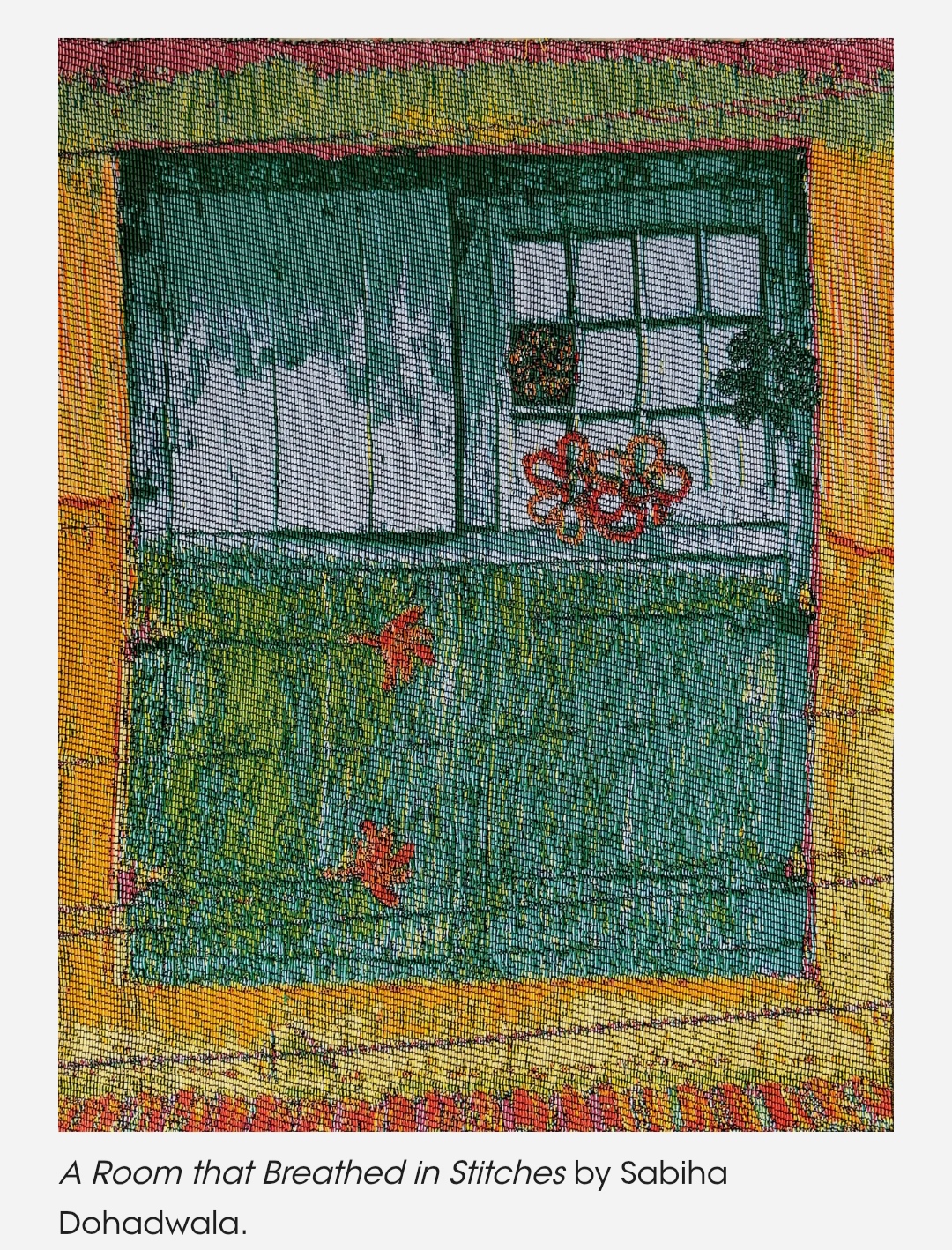
In the stitched room,
the window does not promise escape.

The window is not open.
The window is performing openness.

It offers a square of green
held in place by patient lines.

Outside, perhaps, there is weather.
Inside, mother's old cloth has taken over
the duties of wall, curtain, garden, memory.

Behind its green ribs,
a pot of flowers rehearses spring
in a room that has never trusted weather.

The flowers keep their colour
without asking the sun’s permission.

Two red leaves have fallen
where nobody invited autumn in.

A red leaf comes and rests near the threshold
like a thought someone dropped
and did not return for.

I stand before this room
and think of all the places
that were called safe
because they had doors.

This is how houses confess:
not by speaking,
but by loosening a seam,
staining a corner,
letting one curtain sag
after years of being looked through.

A seam is not a wound, exactly.
It is the record
of two torn edges
agreeing, for now,
to remain together.

I touch the wall.
It gives slightly.

It does not fall.
It does not forgive.

Never collapses.
Never surrenders.

Only the smallest admission
that even brick grows tired
of being called shelter.

~ Oizys.

Written for dVerse Poetics Tuesday: What art says, hosted by paeansunplugged on Tuesday, May 12th, 2026. The prompt asked us to write a poem inspired by one of the shared artworks by Indian artists, letting the art speak without further explanation. I chose:
“A Room that Breathed in Stitches” by Sabiha Dohadwala.

Tuesday, May 12, 2026

[dVerse] May 11th - The Bird Did Not Fly

The Bird Did Not Fly

By Tuesday morning, the cage had learned my name. It said it softly, in Ma’s voice, from the kitchen window where the caged parrot hung beside the basil. I had returned after twelve years, with a suitcase and no husband, which in our lane was worse than arriving with a corpse. Ma made tea. The parrot scraped its beak against the brass bars. “You can sleep in your old room,” she said, as if mercy had furniture. I opened the window. Outside, the night jasmine leaned in, reckless, fragrant, almost free. And the faint perfume from its chalice steals— into the room, into the cage, into my lungs. The bird did not fly when I opened the latch. Neither did I. We only looked at each other, ashamed of our training.

~ Oizys.

Word count: 131
Written for dVerse Prosery — Paul Laurence Dunbar, hosted by Dora on May 11, 2026. The prompt asked us to write a piece of prose fiction in 144 words or fewer, using the line from Dunbar’s Sympathy: “And the faint perfume from its chalice steals—” This is fiction. Mostly. The cage is innocent until proven hereditary.

Sunday, May 10, 2026

All roads lead to rome. Mine lead to rot.

On Saturday, I am spiralling down the depression-anxiety-low-self-esteem trifecta again, with bouts of anger throwing my body around like it owes me something. I am not eating, not really, but then I down two bags of chips as if salt can fill a perpetual hole that I have created. It only accelerates the migraine, makes the room tilt, makes my stomach revolt until I am spinning and puking and sitting there with the familiar shame of having failed at even taking care of this one body. This utmost self-disrespect. 

And while I was binging chips, I binged the new seasons of Lidia Poët.¹ I had watched the first season quite early, some time back, so returning to it felt strangely comforting... like opening a room I had once lived in, now with dust settled on the furniture. There is something tender about watching a new season of a show you already know. You do not enter it as a stranger. You come back with memory, with expectation, carrying your old self and meet whatever version of you is watching it now. Obviously, watching the show gave me a complex. Of course it did. How could it not? There she was, fighting against a hegemonic, archaic, patriarchal, utterly misogynistic system to practice law, pushing through a world that kept telling her she had no place in it. She was witty, restless, disobedient, intelligent in that sharp, almost dangerous way. She went through so much, wanted so much, lost so much, and still kept walking into rooms where she was not invited. She argued, investigated, desired, succeeded, failed, tried again, succeeded, AND never seemed to lose her ground completely. She did not shrink just because the world demanded it. All things I am not. Or at least, all things I tell myself I am not when the trifecta has me by the throat. Depression says: you have no energy. Anxiety says: even if you had energy, you would ruin everything. Low self-esteem says: and anyway, who do you think you are? So I sit there, watching this woman fight entire systems, while I cannot even fight the urge to destroy my body with salt and shame. I watch her refuse to disappear, and I feel both admiration and resentment blooming in me like something poisonous. It is not that I do not want her bravery. I want it so badly that looking at it hurts. I want that stubbornness, that clarity, that refusal to back down. But in me, everything brave feels buried under fear. Everything fierce feels delayed. Everything possible feels like it belongs to some other woman, in some other life, in some better-lit room. And then there was the scene with the prosecutor. That scene gave me such fluffy, flowery feelings that I almost, almost got over my depression for a while. Ridiculous, no? A few minutes of chemistry and suddenly the walls had curtains, the air had perfume, the body remembered it was not only a burden but also a place where warmth could live. There was something soft and cozy and quietly sexy about it: not loud, not vulgar, not desperate to prove itself. Just charged. Gentle. Human. I know, I know. I have never really spoken up about this. About love. About sex. About intimacy. How can I? I have a complicated, tangled, almost embarrassing relationship with all of them. I want them and fear them. I mock them and ache for them. I pretend to be above them, then one tender fictional moment comes along and I am undone like a teenager hiding a love letter under her mattress. But their chemistry—his softness, his understanding, the space he gave her to be messy, difficult, brilliant, impulsive, and still entirely herself—it did something to me. It is rare for me to hold on to a couple like this. Rare for me to latch on. Usually I watch romance like someone standing outside a lit house in winter, pretending I am only passing by. But this felt warm enough that I stopped walking. Ah. Like I said, I almost, almost got over my depression. Almost. Because even those soft, cozy feelings eventually curdled into insecurity. Then jealousy. Jealousy of what, exactly? A fictional story? Historical shadows? A couple who may or may not have existed like this? A love written by other people, performed by actors, lit by professionals, edited into perfection? Sick and silly me. It is like they say, all roads lead to Rome. But for me, all roads lead to rot. Even beauty finds a way to bruise me. Even tenderness becomes a mirror. Even a scene that should have made me sigh and sleep peacefully instead opened some small, hungry room inside me where all the old questions were waiting. Why not me? Why not my life? Why am I always watching from outside? Why does softness feel like something I must earn by becoming someone else first?

I keep ruminating over lost opportunities. All I could have done. All I could have been. All I could have seen. All I could have said. All the doors I did not knock on because fear had already locked them from inside. There is a special cruelty in imagining alternate versions of yourself which is brighter, braver, calmer, sharper, and easier to love; and then returning to the one sitting on the floor, nauseous, angry, pitiful, sad, pathetic, ugly, disgusting, fearful, useless, unworthy, and afraid. I tell myself I have no one. Maybe that is not entirely true, but it feels true in the hour when the room goes quiet and my thoughts become a committee of ghosts. They sit around the table of my mind and audit my life with merciless precision. Here is where you failed. Here is where you waited too long. Here is where you should have spoken. Here is where you should have left. Here is where you should have become someone else.

So, on Sunday, I fantasize and daydream as my life loses weight with time. It is a quiet, persistent theft, the way the mirror seems to hold a slightly different reflection each morning which is softer, more tired, but still mine. I sleep on my bed by the window, watching dust motes drift through the afternoon light, and let my mind wander. I build worlds that feel steadier than the one I am standing in. In these daydreams, I am not wasting myself away. I am trying to become lighter, to disappear, and to breathe without the old heaviness pressing against my ribs. I imagine the edges of my life, once sharp and demanding, turning soft and pliable, like an old photograph left in the sun. I paint over the fading colors with vivid scenes of places I have never been: streets carrying the scent of jasmine, shores where the sea crashes with enough force to remind me I am awake. It is a comfortable delusion, this fabric I weave, a soft blanket around shoulders that have forgotten how to carry themselves gently. I tell myself that the weight I lose is not always flesh, not always proof of absence. Some of it, I hope, is the armor I no longer need. The anxiety, the regrets, the iron chains of should have, perhaps they are not gone, but they are loosening. Perhaps that is enough for now. Sometimes, I fear the silence that fills the gaps. The cold reality that creeps in when the daydream fades. But then I take a breath, thin as it may be, and return to the room, to the window, to the light. The story is still mine. No, it is not a perfect one and not even a brave one, always. But it is still being written in the margins of a life that is not weightless yet, only learning. Slowly and stubbornly, how to be held.

~ Oizys.

¹ In one of the two latest seasons, there was a mention Sappho somewhere, which felt like one of those coincidences too pointed to ignore. I had been thinking about Sappho recently too... thinking, rather foolishly and tenderly, of getting a sapphic flag phone case. But alas, my fear remains the most efficient censor I know. My current phone cover broke a little during a trip I took in December 2024, and I have carried it like that ever since. Do not ask me why. Laziness, partly. Sentimentality, maybe. But mostly, I am scared and skeptical. My family has a talent for becoming selectively nosy about the smallest things and then preserving those details like evidence for a future trial. A phone case is never just a phone case in such a house. It becomes a question, then a suspicion, then a weapon. So the broken cover stays, I guess. Ugly, loyal, and safer than honesty. The sapphic flag phone case goes into the box of things I will do when I leave and teleport away... so, like, never? Yeah, that sounds about right!

Saturday, May 9, 2026

Some musings on 'no miracle exit' [29th April 2026 - 9th May 2026]

29/04/2026, 19:50 PM
the body being trapped in the present

The shadows in this room have begun to whisper, mapping out a layout that defies Euclidean geometry. I have checked the door. It’s just a painted mural on cold concrete and the windows are only flickering screens showing a sunny day that never shifts, never changes. If teleportation were real, I’d be in a field of wild lavender right now, feeling the actual sun. Instead, I am just waiting for the final flickering, wishing I could simply will myself elsewhere. A blink. A breath. The sensation of tearing through the air. But there is only here. And I am not going anywhere.
-

30/04/2026, 01:56 AM
teleportation as escape

The morning tea still tastes like the long, tedious, beautiful commute it took to get here. If only teleportation were possible. If only I could step into a glass booth in New York, exhale the scent of rain on concrete, and inhale the salty, impossible air of a cliffside in Santorini, all in the time it takes to click my heels. To cease to be here, and instantly be there. To tear the tapestry of space-time and skip the messy, dusty threads in between. But it is not. Instead, I am bound by the laws of thermodynamics, by the agonizing, beautiful, slow-motion truth that to get to a new place, I must physically inhabit all the old places in between. I must watch the scenery blur, feel the weight of a suitcase, and endure the anticipation. If teleportation were possible, we wouldn’t have postcards. We wouldn’t have the desperate, sweet longing for a destination. We wouldn’t know the joy of arrival. We’d only have perfect copies of ourselves, appearing at our desks, at our dinners, in our lovers’ arms, forever wondering if the "us" who woke up this morning actually survived the commute. But it is not. So I will keep my atoms right here, in this chair, and I will be grateful for the slow, messy journey. I will let the world exist at a distance. I will let the space between here and there remain, filled with everything I am not yet, but might become.
-

30/04/2026, 01:57 AM
the space between here and elsewhere

I am so scared. he is screaming out loud. I can hear the walls vibrating. Why is he doing that? It’s not just noise, of course, that is a primary issue, but it is also like tearing paper in my brain. My heart is acting like a trapped bird, beating against my ribs, just thump-thump-thumping so hard I can feel it in my throat. Why is it so hot in here? I can’t catch my breath, it’s like there’s not enough air in the room, like someone is squeezing my chest. My knees feel like water. I just want to shrink, to shrink into nothing, to crawl into a drawer and lock it. Stop it, stop it, stop it. I can feel my hands shaking. I am trying to hold onto my own hands but they are still shaking. Why is he screaming? Did I do something? Is it my fault? No, please, it is not my fault. Everything is too loud. The air feels thick. The walls are closing in, they are literally moving closer, I swear I can see them. Why is my face wet? Oh, I am crying. I need to breathe, I can't breathe, I can't breathe, I can't breathe. The sound feels like a physical weight, pressing down until there is nowhere left to turn. Every nerve is on edge, waiting for the silence that won't come. It’s hard to focus on anything else when the air is filled with that sound, making it impossible to find a steady thought or a moment of peace. Please, just let there be silence.
-

09/05/2026, 01:19 AM
teleportation is not real

I am writing this days later, but my body does not understand dates. It still thinks it is trapped in that room. It still checks the walls. It still listens for the next raised voice the way people listen for thunder after lightning. There is a cruelty in the ordinary continuation of things. The fan keeps turning. The phone charges. Someone somewhere is chopping coriander. A dog barks, a pressure cooker whistles, a neighbour drags furniture across the floor, and the world has the audacity to remain functional. Meanwhile, some part of me is still standing there, small and alert, waiting for silence to prove it is real. I keep thinking about teleportation. Not the glamorous kind. Not glass booths or blue light or arriving in Santorini with perfect hair and no luggage. I mean the ugly, desperate kind. The kind where the body says: remove me. Not tomorrow. Not after explanation. Not after I have packed a bag, justified myself, made arrangements, behaved sensibly, thanked everyone for their concern. Just remove me. Please. One clean tear in the fabric of here. But there is no such mercy. There is only the body, stubborn and biological, refusing to become mist. There is only the long route out: one breath, then another; one room survived, then another; one morning coffee after a night that did not end properly. Maybe that is why travel feels holy to me. Because distance has to be earned. Why? Because the road proves that leaving is possible, even if it is slow. Why? Because every train platform, airport gate, bus window, and tired suitcase says the same old thing in different accents: You were there. Now you are here. Maybe teleportation would rob me of that evidence. Maybe I need the road because the road leaves witnesses. Ticket stubs. Bad tea. Dust on shoes. A song overheard in a cab. The absurd dignity of dragging luggage across broken pavement. The proof that I crossed something and remained myself. Or maybe I am romanticising inconvenience because the alternative is admitting how badly I wanted to disappear. Both can be true. Please...? Tonight, I do not want lavender fields or Santorini cliffs. I want a room that does not pretend to be a trap. I want a door that is a door. I want windows that do not perform sunlight, but allow it. I want silence without waiting for it to be broken. I want to arrive inside my own life and not flinch. Until then, I will stay with the slow laws of matter. No vanishing. No perfect copies. No miracle exit. Just this body. These atoms. This breath. Still here. Not going anywhere yet.
-

09/05/2026, 01:19 AM
the long route out


Tomorrow my sister will come back home. Or that is the version of the sentence I am allowed to write. According to my mother, she left. According to my mother, she is in the country. According to my mother, many things are true if said firmly enough and repeated near the kitchen sink. But I know she is not. Do not worry. I will not tell anyone. Especially now, when I am not speaking to my mother. There is a strange discipline in silence. People think silence is empty, but it is not. Silence is a room full of labelled boxes of things you know, things you suspect, things you were told not to repeat, and things you figured out anyway because families are terrible at hiding the shape of their own lies. I keep my mouth closed and somehow still feel accused. The house has its own intelligence. It knows who is missing. It knows which slippers have not moved. It knows the difference between a person travelling and a person being edited out of conversation. Tomorrow, she will return, and everyone will behave as if geography is a minor clerical error. Maybe there will be tea. Maybe someone will ask if she ate. Maybe someone will say, “You have become thin/fat,” because that is how love enters cultured homes for the women when it has forgotten the front door. I will not ask where she was. Not because I do not care. Although, I know. But, because I care enough to know that sometimes the truth arrives tired, carrying its own luggage, and the kindest thing you can do is not inspect the baggage at the door. Still, I am angry. Not the loud kind. The clean, cold kind. The kind that sits upright at the dining table and remembers every contradiction. The kind that does not shout because shouting would make it too easy for everyone to call it emotional and move on. I am not speaking to my mother right now. And, this too is a language.A bitter one, yes. But honest. More honest than the carefully polished sentences passed around this house like steel plates. I do not know what tomorrow will bring. Maybe relief or theatre or another version of the story I am expected to swallow without chewing. But I know this: my sister will come back home. And when she does, I will look at her face first. Not for proof, confession, justification, love, support, longing, sisterhood, betrayal. Just to see whether she has returned whole. Everything else can wait.
-

09/05/2026, 03:55 PM
the laws of matter

Why is it that people grow up under one roof, and one abuses the other, and the abuser always gets to go on and have a life? They go on. That is the part that feels obscene. They go on to other countries, other rooms, other photographs. They stand in front of monuments. They eat something pretty from a ceramic plate. They laugh with friends on trips. They make memories. They make videos. They make themselves understandable. Meanwhile, the abused one rots in the corner. Not just poetically. Actually. Rotting is not always dramatic, well, sometimes it is and sometimes we make it, to make rotting sufferable. Sometimes it looks like sitting at a desk and answering emails. Sometimes it looks like doing laundry. Sometimes it looks like being productive enough that no one can accuse you of collapsing, but not alive enough to call it living. I sit. I rot. I work. I write. I labour. I do all the ordinary things required to keep a body officially functioning. And still, some part of me remains in the corner where I was left. I look at this site within my own walls and I recognise the blueprint of society. This is how it works.Home is the first state. Home is the first court, the first police station, the first prison, the first propaganda machine. Home teaches you who is allowed to speak, who must lower their eyes, who gets believed, who gets explained away, who must preserve the family’s dignity by swallowing every sharp object placed in their mouth. Home is where oppressors rehearse. Before the world calls them charming, complicated, misunderstood, promising, emotional, stressed, young, human, the home has already given them a stage. And before the world calls the abused one difficult, bitter, unstable, dramatic, ungrateful, too sensitive, too much, the home has already written that script too. I have seen it, inside these walls. The same architecture. The same excuses. The same redistribution of sympathy. The person who harms gets a future. The person harmed gets a personality diagnosis from people who never witnessed the violence, only the aftermath. And the aftermath is always so inconvenient-looking. It does not photograph well. There are no cute reels for learning to breathe again after someone has made your own body feel unsafe. No aesthetic caption for flinching at footsteps. No travel montage for being unable to leave because every ounce of strength is spent surviving the room you are already in. People who have physically, verbally, emotionally, sexually, psychologically abused and violated me get to go on. They get to travel. They get to have friends. They get to sit around tables and tell stories where I am mostly painted as the villain. And people know those versions. That is another violence. Not the first one, no. Maybe an extension of this one. But it has teeth. The story leaves before you do. It reaches the room early, shakes hands, orders tea, takes the comfortable chair. By the time you arrive, wounded and late and trying not to shake, everyone has already been introduced to your caricature. The villain. The liar. The mad one. The problem. The one who destroys peace by naming the war. And what can you say then? How do you explain abuse to people who are already suspicious of your mouth? How do you narrate violation without being cross-examined by people who think neutrality is a virtue, when neutrality is often just cowardice wearing clean clothes? The abused are expected to provide perfect testimony. No contradictions. No rage. No ugliness. No memory gaps. No inconvenient timing. No grief that makes others uncomfortable. We must be articulate, but it cannot rehearsed. We must be broken, but it cannot messy. 
We must be honest, but please not too detailed. We must be hurt, but do not accusing. We must be forgiving, preferably. We must be quiet, ideally. And if we cannot do that, then perhaps we are unreliable. Perhaps it was not that bad. Perhaps both sides. Perhaps family. Perhaps move on. Move on. What a clean little phrase like a broom pushed over blood. People say it as if movement is available to everyone equally. As if leaving is only a question of courage. As if the abused body has not been trained, over years, to freeze before it can run. As if money, health, work, friendship, housing, documentation, shame, exhaustion, fear, and the slow erosion of self are not also locks. All we get are strange corners of the internet with ;ittle digital cupboards where we can place our unbearable sentences and weird anonymous rooms where we fantasise about teleportation because the actual routes out require energy we were never allowed to keep. The body is not merely tired. It is harvested and cultivated and systemically kept tired. That is the part people do not understand. Or, refuse to understand for their own peace. Abuse steals labour before labour can become escape. It takes sleep, concentration, confidence, appetite, time, decision-making, tenderness, memory. It takes the clean morning in which a person could have applied for a job, called a friend, planned a move, studied, saved money, built a life. It takes the future in small daily withdrawals. Then the abuser returns and asks why you have nothing. Why are you still here? Why are you like this? Why can’t you be normal? Why don’t you do something with your life? As if they did not stand at the door of that life and charge a toll in fear. As if they did not keep coming back to break the tools. As if they did not benefit from your stuckness. Because that is the design, isn’t it? It's intentional. Keep the abused close enough to access. Weak enough to control. Ashamed enough to stay silent. Isolated enough to doubt their own memories. Exhausted enough to fail at escape. Then step outside and become a person among people. Tell sob stories. Receive comfort. Go on beautiful trips. Let friends say, “You deserve happiness.” Upload the sea. Upload the mountains. Upload the laughing, forgiven face. And somewhere, in a room no one is filming, the person they harmed is trying to convince her nervous system that the door is real. I hate this. I hate the injustice of it with a clean, ancient hatred. I hate that survival makes the abused look smaller while impunity makes the abuser look well-adjusted. I hate that the world loves a healed survivor but distrusts a bleeding one. I hate that pain must become literature before anyone will sit with it and sit with the discomfort. 

And still, I write. Not because writing saves me. Well, maybe momentarily. But, not tangibly. Let us not be sentimental. Writing does not unlock doors. It does not pay rent. It does not erase hands, words, threats, rooms, nights. It does not make the body forget what it had to learn. But writing does one stubborn thing. It refuses the official record. It says: no. No, that is not what happened. No, I was not born difficult. No, my silence was not proof that nothing occurred. No, their happiness is not evidence of their innocence. No, my corner is not my natural habitat. No, I am not a villain because I remember. Tonight, I do not want revenge. Revenge would still keep me tied to the architecture. I want exit. I want witnesses who do not ask me to bleed politely. I want a life where my labour finally returns to me and my body. I want friends who know my story from my mouth. I want a room where no one weaponises volume. I want mornings that belong to the future and not to recovery. I want my body to stop mistaking peace for the brief pause before harm resumes. And yes, I still want teleportation, not to disappear forever. Just to stand once, even once, in a place untouched by their version of me. A field. A train platform. A rented room with a working lock. A city where no one knows the family mythology. A small table near a window. A cup of tea going cold for ordinary reasons. Somewhere I can say my own name and not hear it returned as an accusation. Until then, I remain here. Not because here deserves me or I forgive the walls or the story is over. But because even rotting things know something about soil, even corners gather dust into evidence, even a body trained for fear can one day relearn distance. I am not the version they carried into other rooms. I am the witness they failed to kill. I am the archive with a pulse. And one day, when I leave, it will not be teleportation. It will be slower. Messier. More humiliating [for them]. More real. I will cross every inch of the distance they said I could not survive. And when I arrive, I will know this with my whole, exhausted, disobedient body: I did not vanish. I escaped.
-

~ Oizys.

Friday, May 8, 2026

[dVerse] May 7th - The Fog Has My House Keys

The Fog Has My House Keys

The fog comes in
like it has been here before.

Not dramatically.
No doorbell.
No throat-clearing at the gate.
No screaming.
No door-slamming.

Just a soft trespass
over the balcony railing,
through the laundry clips,
past the basil plant
that has seen too much
and says nothing.

By midnight,
the buildings lose their surnames.

The streetlights become
small government offices
processing applications
for disappearance.
Outside, men in uniform guide
dispossession in a line.

Even the stray dog
below my window
forgets his argument
with the moon.

I stand there,
holding a cup of tea
gone cold from wilful neglect,
and watch the world
misplace itself politely.

There is mercy in this. (Please...)

How kindly the fog
edits the city,
removing sharp edges,
pending bills,
unanswered messages,
the exact shape
of my own face
in the glass.

For a few minutes,
I am not required
to be clear.

Not daughter.
Not employee.
Not woman definitely.
Not a worker
with a calendar full
of practical weather.

Only breath.

Only blur.

Only some small animal
passing through the chest,
quiet-footed,
unclaimed,
already leaving.

~ Oizys.

Written for dVerse Open Link Night #407. Inspired by their given optional mini prompt from Carl Sandburg’s Fog, especially the line “The fog comes on little cat feet.”

Wednesday, May 6, 2026

[dVerse] May 5th - Names I Did Not Answer To

Names I Did Not Answer To

By midnight,
all my old selves had gathered
outside the locked door.

Restless came first,
barefoot, carrying a suitcase
full of unsent apologies.

Then Ebb Tide,
who knew exactly
when to leave a room
and make it look
like drowning.

Desdemona wore white,
not for innocence,
but because grief stains better
on honest cloth.

No Surrender laughed
from the staircase,
mouth full of thunder,
heart full of municipal paperwork.

I almost opened the door.

But Peace arrived late,
as usual,
with cold hands
and no explanation.

Behind her,
White Wings folded themselves
into the corridor light.

And for once,
none of my names
asked to be forgiven.

They only stood there,
breathing,
as if survival
was also a kind
of fragrance.

~ Oizys.

Used prompt names: Restless, Ebb Tide, Desdemona, No Surrender, Peace, White Wings
Avoided word: rose
Written for dVerse Poetics - “Names of the Rose,” May 5, 2026. The prompt asked us to use at least five names from a list of rose varieties, without using the word “rose.”
Linky widget expired by the time I could post it. Hope someone sees it. Someone reads it.

Tuesday, May 5, 2026

[dVerse] May 4th - Bloom: Filed Under Pending

Bloom: Filed Under Pending

Tuesday arrived late,
wearing Monday’s floral badge.

I opened the prompt
like unpaid mail.

Inside: bloom.

Garden bloom? No.
Obedient marigold? No.

More like fungus
on old grief:
tender, suspicious,
still choosing light

from the damp corner
where I had filed
myself under
pending.

~ Oizys.

Word count: 44
Written for dVerse Quadrille Monday: “Come Bloom With Me!!!” May 4, 2026.

Friday, May 1, 2026

1st May 2026, after the village folds itself away

1st May, 2026. 08:10 PM.

Maureen has posted the final housekeeping note. Which means it is official now. April has been packed into boxes, the prompts have been swept from the floor, the links are still warm, the comment threads are still glowing faintly, and somewhere, thirty poems are lying around in my blog like guests who refused to leave before breakfast. Na/GloPoWriMo is over. Every year, this feels strange. For most of the year, my weblog is a quiet corner of the internet. A room with one chair, one flickering tube light, one stubborn spider, and me, rearranging my feelings badly. Then April comes. Suddenly, the room becomes a village. People arrive with their poems, their griefs, their jokes, their gods, their dead, their weather reports, their strange little mythical professions. Someone sets up a stall of metaphors. Someone brings a basket of crows. Someone arrives late with a mermaid. Someone is crying near the mangoes. Someone has misplaced a childhood and is filling out the correct form. For one month, we read each other. What a small sentence. What a large mercy. Thank you, Maureen, for building this temporary country every year. Thank you for the prompts, the resources, the patience, the housekeeping, the doors left open. And thank you to everyone who stopped by here, read, commented, left a line, carried a line away, or simply passed through quietly. You made this weird, little weblog less lonely. May has begun now. The village has not vanished exactly. It has only folded itself into pockets, bookmarks, drafts, names we will search for next year. And perhaps, before next April, I may wander into dVerse too! A poetry space Maggie (a fellow Na/GloPoWriMo poet!) kindly introduced me to. Maybe there will be other prompts, other doors, other rooms where words gather and refuse to behave. Until then, may poetry find us where we are hiding. See you next April.

08:50PM.

Also, because April has left me with too many names to lose, I have started a separate register on my Junkyard of Readees page: Fellow Na/GloPoWriMo Good Poetry Co-Citizens [as said by Maureen herself!]. A small roll call of poets, prompt-survivors, comment-leavers, line-barterers, and temporary neighbours from the April poetry village. Some read me. Some I read. Some left lamps in the comments. Some wrote poems I am still carrying. So I am keeping their names there, like pressed flowers, like forwarding addresses, like proof that the village happened. It is an ever-growing register, so I will keep adding names as I find them, remember them, and follow their little lanterns back through April.

~ Oizys.