Showing posts with label poet. Show all posts

Monday, June 29, 2026

[dVerse] June 25th — Ars Poetica with a Faulty Exit Door

A poem seldom arrive clean.

It comes in through the window
with dust on its knees,
carrying one cracked cup,
one unpaid bill,
one mother’s voice pressed
against the wrong side of a door.

It rarely ask for a desk.

It sits on the floor
beside the body
and begins taking attendance.

Here is the throat,
still functioning as a checkpoint.

Here is the stomach,
refusing citizenship.

Here is the girl under the desk,
still waiting for the bell
to mispronounce freedom.

A poem should never be used as a lantern.
Do not insult it with usefulness.

A poem is the matchstick
struck inside a locked room,
not enough to save anyone,
but... just enough to prove
there was oxygen here once.

Sometimes it is a witness statement.

Sometimes it is the broken crayon
smuggled out of childhood.

Sometimes it is my own handwriting
dragging a chair
to the centre of the court
and saying:

your honour,
the body remembers
what the father edited out.

As I have said before,

I do not write
because language heals.

I write because silence
keeps trying to inherit me.

I write because the wound
has developed clerical skills
and keeps misfiling my life
under manageable woman.

I write because somewhere
inside this humiliating machinery
there is still a small illegal door
with my name misspelled on it.

The poem finds it first.

Then it waits,
barefoot,
ink-mouthed,
disobedient,

until I remember
Wednesday, June 17, 2026

[dVerse] June 16th - I was given eight crayons and drew a witness statement.

The first box had eight colors
and no instructions for grief.

Red was for apples, they said,
as if blood had not already invented itself?
Red is:
the notification I still haven't opened,
the lipstick I wore like an alibi,
the danger my mother taught me to notice before language.


Yellow was the sun,
as if jaundice, turmeric, caution tape,
and old gods did not live there too?
Yellow is:
old turmeric under the nail,
a streetlight pretending to protect me,
the cheap brightness of sunshine-flavour optimism sold in bulk.


Blue was for sky, they said,
as if drowning did not also look upward?
As if a bruise was not simply the body
learning how to keep a record?
Blue is:
some say, sadness,
but it's not sadness exactly,
it's the bruise of learning grammar to write the wounds.


Green was for grass, they said,
as if envy had not already rented a room
inside the chest?
As if mold did not know
how to make a home of what was abandoned?
Green is:
mold on the thing you meant to become,
and moss on others who became that thing.

Black was for night, they said,
as if night were the worst thing
a room could become?
As if absence had no color
until we were made to sit inside it?
Black is:
not death, but the room after everyone says “move on.”

Give me the broken crayon,
the one without a wrapper,
the one no child can name.
I will use it
to draw the door
and then misbehave my way through it.
 
~ Oizys.
 

Thursday, May 21, 2026

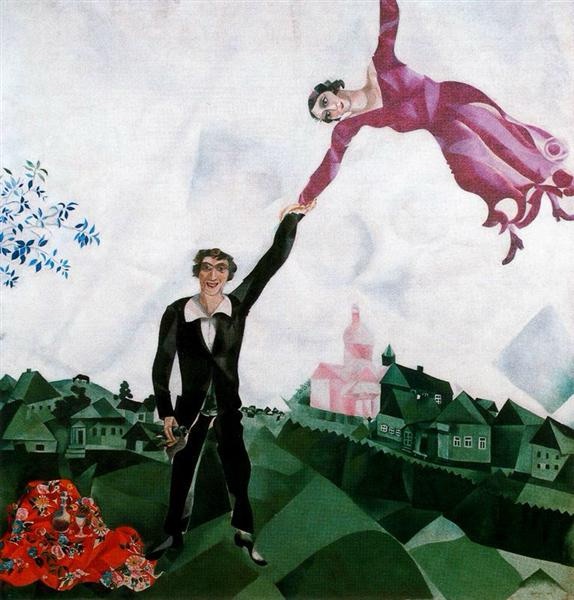
[dVerse] May 19th - This Is Not a Walk

This Is Not a Walk
after Chagall’s La promenade

Marc Chagall, La promenade (The Promenade) (1918), oil on canvas

This is not a woman flying.
This is not a man holding the wrist of his weather.
This is not love,
though love is often accused of such public misconduct.

The green beneath them is not a field.
It is not obedience pretending to be grass.
It is not the ancestral courtyard where daughters learn how low the sky can be.

The houses are not houses.
They are not witnesses with their windows buttoned shut.
They are not relatives leaning out to ask where she is going
in that dress,
with that body,
with that much altitude.

The bouquet is not a bouquet.
It is not apology.
It is not proof that romance has completed its paperwork.

The small red church is not a church.
It is not permission.
It is not the office where joy must apply
for a identity certificate,
salary slip, father’s signature,
and two passport-size photographs.

And he—the man on the ground—
is not a saviour.

Let us be clear.

He is not gravity.
He is not ownership.
He is not the nail holding her blue hem to the village map.

He is only a hand still surprised to be trusted.

She is not escaping.
She is not performing lightness for the museum wall.

She is what happens when the body remembers
it was never a cupboard,
never a locked room,
never the careful daughter
folded into the good bedsheet.

Above them, the sky
is not blue.
It is not sky.
It is a loophole.

And the air—that shameless clerk—
has misplaced every form
that once required her
to stay.

~ Oizys.

Written for dVerse Don’t box me in: Chagall by Melissa Lemay on May 19, 2026.

Tuesday, May 19, 2026

[dVerse] May 18th - safety through ugliness

safety through ugliness

the phone cover sheds
its tired skin
while I eat
a sandwich late.
hunger sits beside me,
loyal as a dog,
waiting for the command
to leave.
I say stay.
it stays.
I say live.
it looks away,
like I am asking too much.

~ Oizys.

Word count: 44
Written for dVerse Quadrille #248 – This One’s Gone to the Dogs By whimsygizmo on May 18, 2026.

Friday, May 15, 2026

[dVerse] May 15th - Inventory for Staying Alive in Public

One safety pin fastened to the inside of a wobbly long top.
One phone charged to 63%, which is not enough, but is treated like faith.
One friend who knows the cab number, the driver’s name, the route, and the exact hour to begin worrying.
One lipstick that has outlived three men and two versions of the self.
One packet of tissues.
One packet of lies: I’m almost there. / My brother is waiting outside. / I don’t live alone. / I have already sent your photo.
One key held between fingers like an ancestral weapon nobody officially taught us.
One mother’s voice stored in the body: sit properly, come home early, do not argue with strangers, do not become a story people tell in lowered voices.
One father’s silence after the screams folded into the wallet like an old receipt for a life nobody returned.
One group chat named something harmless where women exchange weather reports on men, streets, bosses, landlords, family functions, and which uncle not to sit beside.
One chocolate bar for blood sugar, rage, or the sudden need to remain human.
One screenshot.
One backup screenshot.
One joke made too quickly so fear does not get ideas.
One scarf adjusted, not for modesty, just for strategy.
One woman at the bus stop making eye contact with another woman and becoming, briefly, anti-establishment infrastructure.
One memory of being told not to make a scene.
One scene, kept ready.
One small private terror that the city is not the cage, only the corridor outside it.
One small 
private terror that leaving home might not mean leaving inheritance.
One small private terror that I have not left home; I have only learnt to carry it more quietly. I have only become more portable.
One recurring thought while waiting for the lift, the salary, the apology, the visa, the miracle: what if this is not a phase but the whole arrangement?
One small, stubborn tenderness: the little girl on the bus offering her seat to someone more tired than herself.
One performative prayer, not to be protected, but to arrive without having to become stone.
One ordinary evening.
One ordinary survival.
One ordinary woman unlocking her door, removing her earrings, and entering her own name again.

~ Oizys.

Written for dVerse Meeting the Bar: Unlock with lists, hosted by Björn Rudberg on Thursday, May 14th, 2026. The prompt asked us to use lists in poetry as structure, metaphor, inventory, negation, expansion, or simply as a way to begin. This is a list poem. Also a handbag audit. Also, unfortunately, a syllabus.

Wednesday, May 13, 2026

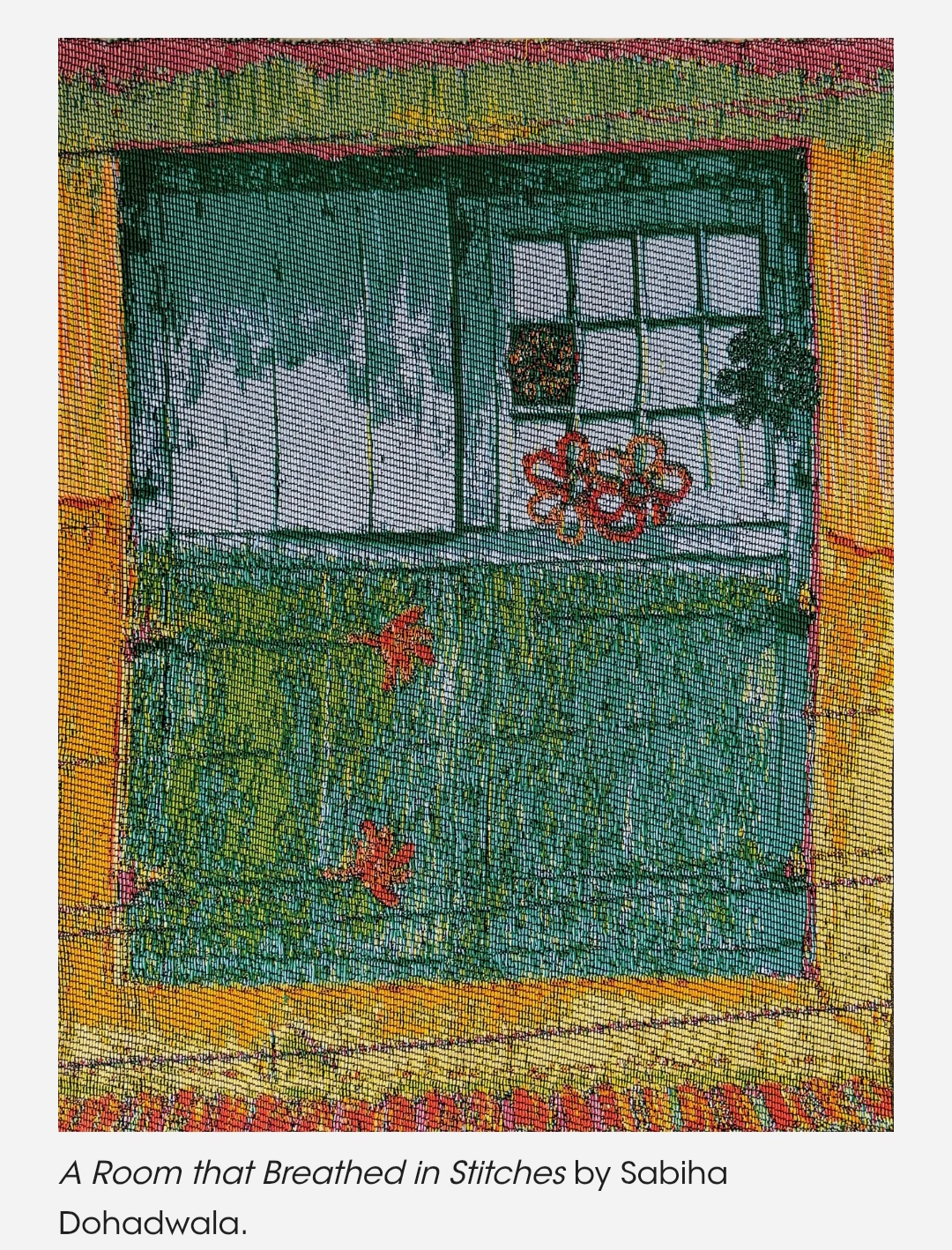
[dVerse] May 12th - A Room that Misremembers its Windows

A Room that Misremembers its Windows

In the stitched room,
the window does not promise escape.

The window is not open.
The window is performing openness.

It offers a square of green
held in place by patient lines.

Outside, perhaps, there is weather.
Inside, mother's old cloth has taken over
the duties of wall, curtain, garden, memory.

Behind its green ribs,
a pot of flowers rehearses spring
in a room that has never trusted weather.

The flowers keep their colour
without asking the sun’s permission.

Two red leaves have fallen
where nobody invited autumn in.

A red leaf comes and rests near the threshold
like a thought someone dropped
and did not return for.

I stand before this room
and think of all the places
that were called safe
because they had doors.

This is how houses confess:
not by speaking,
but by loosening a seam,
staining a corner,
letting one curtain sag
after years of being looked through.

A seam is not a wound, exactly.
It is the record
of two torn edges
agreeing, for now,
to remain together.

I touch the wall.
It gives slightly.

It does not fall.
It does not forgive.

Never collapses.
Never surrenders.

Only the smallest admission
that even brick grows tired
of being called shelter.

~ Oizys.

Written for dVerse Poetics Tuesday: What art says, hosted by paeansunplugged on Tuesday, May 12th, 2026. The prompt asked us to write a poem inspired by one of the shared artworks by Indian artists, letting the art speak without further explanation. I chose:
A Room that Breathed in Stitches” by Sabiha Dohadwala.

Tuesday, May 12, 2026

[dVerse] May 11th - The Bird Did Not Fly

The Bird Did Not Fly

By Tuesday morning, the cage had learned my name. It said it softly, in Ma’s voice, from the kitchen window where the caged parrot hung beside the basil. I had returned after twelve years, with a suitcase and no husband, which in our lane was worse than arriving with a corpse. Ma made tea. The parrot scraped its beak against the brass bars. “You can sleep in your old room,” she said, as if mercy had furniture. I opened the window. Outside, the night jasmine leaned in, reckless, fragrant, almost free. And the faint perfume from its chalice steals— into the room, into the cage, into my lungs. The bird did not fly when I opened the latch. Neither did I. We only looked at each other, ashamed of our training.

~ Oizys.

Word count: 131
Written for dVerse Prosery — Paul Laurence Dunbar, hosted by Dora on May 11, 2026. The prompt asked us to write a piece of prose fiction in 144 words or fewer, using the line from Dunbar’s Sympathy: “And the faint perfume from its chalice steals—” This is fiction. Mostly. The cage is innocent until proven hereditary.

Friday, May 8, 2026

[dVerse] May 7th - The Fog Has My House Keys

The Fog Has My House Keys

The fog comes in
like it has been here before.

Not dramatically.
No doorbell.
No throat-clearing at the gate.
No screaming.
No door-slamming.

Just a soft trespass
over the balcony railing,
through the laundry clips,
past the basil plant
that has seen too much
and says nothing.

By midnight,
the buildings lose their surnames.

The streetlights become
small government offices
processing applications
for disappearance.
Outside, men in uniform guide
dispossession in a line.

Even the stray dog
below my window
forgets his argument
with the moon.

I stand there,
holding a cup of tea
gone cold from wilful neglect,
and watch the world
misplace itself politely.

There is mercy in this. (Please...)

How kindly the fog
edits the city,
removing sharp edges,
pending bills,
unanswered messages,
the exact shape
of my own face
in the glass.

For a few minutes,
I am not required
to be clear.

Not daughter.
Not employee.
Not woman definitely.
Not a worker
with a calendar full
of practical weather.

Only breath.

Only blur.

Only some small animal
passing through the chest,
quiet-footed,
unclaimed,
already leaving.

~ Oizys.

Written for dVerse Open Link Night #407. Inspired by their given optional mini prompt from Carl Sandburg’s Fog, especially the line “The fog comes on little cat feet.”

Wednesday, May 6, 2026

[dVerse] May 5th - Names I Did Not Answer To

Names I Did Not Answer To

By midnight,
all my old selves had gathered
outside the locked door.

Restless came first,
barefoot, carrying a suitcase
full of unsent apologies.

Then Ebb Tide,
who knew exactly
when to leave a room
and make it look
like drowning.

Desdemona wore white,
not for innocence,
but because grief stains better
on honest cloth.

No Surrender laughed
from the staircase,
mouth full of thunder,
heart full of municipal paperwork.

I almost opened the door.

But Peace arrived late,
as usual,
with cold hands
and no explanation.

Behind her,
White Wings folded themselves
into the corridor light.

And for once,
none of my names
asked to be forgiven.

They only stood there,
breathing,
as if survival
was also a kind
of fragrance.

~ Oizys.

Used prompt names: Restless, Ebb Tide, Desdemona, No Surrender, Peace, White Wings
Avoided word: rose
Written for dVerse Poetics - “Names of the Rose,” May 5, 2026. The prompt asked us to use at least five names from a list of rose varieties, without using the word “rose.”
Linky widget expired by the time I could post it. Hope someone sees it. Someone reads it.

Tuesday, May 5, 2026

[dVerse] May 4th - Bloom: Filed Under Pending

Bloom: Filed Under Pending

Tuesday arrived late,
wearing Monday’s floral badge.

I opened the prompt
like unpaid mail.

Inside: bloom.

Garden bloom? No.
Obedient marigold? No.

More like fungus
on old grief:
tender, suspicious,
still choosing light

from the damp corner
where I had filed
myself under
pending.

~ Oizys.

Word count: 44
Written for dVerse Quadrille Monday: “Come Bloom With Me!!!” May 4, 2026.

Friday, May 1, 2026

1st May 2026, after the village folds itself away

1st May, 2026. 08:10 PM.

Maureen has posted the final housekeeping note. Which means it is official now. April has been packed into boxes, the prompts have been swept from the floor, the links are still warm, the comment threads are still glowing faintly, and somewhere, thirty poems are lying around in my blog like guests who refused to leave before breakfast. Na/GloPoWriMo is over. Every year, this feels strange. For most of the year, my weblog is a quiet corner of the internet. A room with one chair, one flickering tube light, one stubborn spider, and me, rearranging my feelings badly. Then April comes. Suddenly, the room becomes a village. People arrive with their poems, their griefs, their jokes, their gods, their dead, their weather reports, their strange little mythical professions. Someone sets up a stall of metaphors. Someone brings a basket of crows. Someone arrives late with a mermaid. Someone is crying near the mangoes. Someone has misplaced a childhood and is filling out the correct form. For one month, we read each other. What a small sentence. What a large mercy. Thank you, Maureen, for building this temporary country every year. Thank you for the prompts, the resources, the patience, the housekeeping, the doors left open. And thank you to everyone who stopped by here, read, commented, left a line, carried a line away, or simply passed through quietly. You made this weird, little weblog less lonely. May has begun now. The village has not vanished exactly. It has only folded itself into pockets, bookmarks, drafts, names we will search for next year. And perhaps, before next April, I may wander into dVerse too! A poetry space Maggie (a fellow Na/GloPoWriMo poet!) kindly introduced me to. Maybe there will be other prompts, other doors, other rooms where words gather and refuse to behave. Until then, may poetry find us where we are hiding. See you next April.

08:50PM.

Also, because April has left me with too many names to lose, I have started a separate register on my Junkyard of Readees page: Fellow Na/GloPoWriMo Good Poetry Co-Citizens [as said by Maureen herself!]. A small roll call of poets, prompt-survivors, comment-leavers, line-barterers, and temporary neighbours from the April poetry village. Some read me. Some I read. Some left lamps in the comments. Some wrote poems I am still carrying. So I am keeping their names there, like pressed flowers, like forwarding addresses, like proof that the village happened. It is an ever-growing register, so I will keep adding names as I find them, remember them, and follow their little lanterns back through April.

~ Oizys.

Thursday, April 30, 2026

30th April 2026, after the rain, when the April ends

30th April 2026. 8:30 PM.

It is a different kind of pain. The whole day I was so busy with work, I forgot today was the last day of April. In the few minutes I got between tasks, I scrolled past the same posts on social media: April is ending, May May is kind to us. And then, between one soft farewell to April and another, the news: the Gaza-bound Global Sumud Flotilla had been intercepted in international waters near Crete, its boats seized, its people detained, its attempt at aid folded once again into the old settler-colonial machinery of force. So there it was: people asking May to be gentle, while somewhere on the sea, gentleness was being boarded by armed men.

In the same scroll, I found Coffees for Gaza, asking people for the price of a coffee, which is such a small and devastating unit of measure. A coffee. A coffee: that small office sacrament, that bitter little permission slip to continue. The thing we buy while answering emails, while refreshing dashboards, while telling ourselves we are tired. The thing we hold while answering emails and pretending the world is not on fire. Somewhere, that same amount becomes rice, medicine, a little time, a family not being abandoned completely. This is the vulgarity of distance: our caffeine, someone else’s survival. So, if you can, give one small coffee’s worth away; let it become something warmer than habit.
Well. Finally, after work, in the evening, there was a sudden thunderstorm. Unreasonably justified. Violent wind, lightning, and then an orgasmic rain. It unfurled into something wilder while my mother and I struggled to rescue our clothes from the balcony. Later, my mother brought news from downstairs: the dome over the gate light had flown away, and the bulb had been thrown inward, as if even electricity had briefly lost its manners. Since then, it has been cooler. Calmer. My belly, however, is jealous due to its gaseous nature right now, which is to say, even my stomach has chosen metaphor today. Everything inside me is rearranging itself with unnecessary drama. The rain has stopped now, but the trees are still behaving like they know a secret. The streetlight outside has turned the wet road into something almost holy, which is rude of it, frankly, because I am not in the mood for holiness. I am in the mood for lying down like a historical ruin and being discovered centuries later by archaeologists who say, ah yes, here we see the remains of a woman who answered too many emails. April ended while I was working. NaPoWriMo almost ended while I was working. This feels like betrayal, but not by April. By myself, perhaps. Or by adulthood, that badly managed institution. I spent the last day of a month that asked me to write every day staring at dashboards, messages, tasks, little boxes of urgency multiplying like damp insects. Somewhere in between, people were posting their tender farewells to April, asking May to be gentle, kind, soft, bearable. And I, professional fool, scrolled past them like a clerk at the border of feeling. Only later, when the wind began throwing itself against the windows, did I remember. Oh. Today is the last day. The month is leaving. I had imagined I would notice it properly. That I would sit with tea, maybe. That I would look back at thirty poems and feel something cinematic and clean. Closure, perhaps. A word invented by people who have never owned a nervous system. Instead, there was thunder. There was the sky losing patience. There was rain arriving with the kind of confidence I have only seen in women who have finally had enough. And then, suddenly, coolness. As if the world had been slapped and forgiven in the same minute. I stood there listening to it, and for once, I did not try to make it useful. Not a poem, not a lesson, not evidence. Just rain. Just the last evening of April arriving late to its own farewell, drunk on lightning, smelling of wet dust and bad decisions.

NaPoWriMo is a temporary room. For one month, my little weblog, which otherwise sits like an empty corner of the internet with one tube light flickering bravely above it, becomes part of a village. People arrive. They read. They leave small lamps in the form of comments. They say, I was here. I saw this. I carried this line away. It is the only festival my weblog knows. A strange annual fair where everyone puts up a stall made of drafts and panic, where we bring our unfinished metaphors, our stubborn griefs, our weather reports, our dead, our jokes, our gods, our badly behaved childhoods. We barter words. We trade courage. We taste each other’s strange little offerings and say, yes, this has salt, this has smoke, this burned my tongue a little, thank you. And then, as suddenly as it began, the stalls come down. The room empties. The village goes back to being scattered houses with blue-lit windows. But for a month, there was company. For a month, this empty corner had footsteps and the silence had witnesses. For that, I am grateful.

Maybe this is the correct ending? Perhaps, not a grand summation or some neat little ribbon around the month. Just work, weather, a jealous belly, and the old body continuing its strange negotiations with air. April did not end like a door closing. It ended like a storm passing through a tired city and leaving the rooms cooler than before. And maybe that is enough? Maybe May does not need to be kind. Maybe it only needs to leave one window unlatched, one evening unruined, one small hour in which I remember that I am not only the person who works, worries, digests poorly, and scrolls past tenderness. I am also the person who notices rain. Late, perhaps. But still.

~ Oizys.

NaPoWriMo 2026 [April 30] - Archivists of Lost Girls or, The People Who Remove Childhoods

NaPoWriMo 2026 [April 30]

Day Thirty

Well, it’s happened again. We’ve come to the last day of another National/Global Poetry Writing Month. We’ll be back tomorrow with a final featured participant and some housekeeping details, but in the meantime, congratulations to all who have made it to the end! And if your output has tapered off or been spotty — no worries! The best thing about Na/GloPoWriMo is that every day you write a poem, you get a poem-shaped prize.

Our featured participant today is words with ruth, where you’ll find a complex, tender response to Day 29’s past-and-present prompt.

Our final feature resource is poet and professor Judy Jordan’s YouTube videos covering individual poems and discussing poetic craft.

And now, here’s this year’s final (optional) prompt. In his poem, “Angels,” Russell Edson speaks of these spiritual warrior-messenger-guardians as if they were a type of endangered animal. Brief as it is, the poem is disorienting in its use of flattened diction, odd similes, and elliptical statements. Today, try writing your own poem that discusses a real or mythical being or profession (demons, firefighters, demonic firefighters) with the same sort of musing yet dispassionate tone.

Happy writing!

-

My offering for Day Thirty. My final offering of this year: 

Archivists of Lost Girls
or, The People Who Remove Girlhoods


The people who remove girlhoods do not wear uniforms.
This is one reason they are difficult to report.
They arrive gradually, like mildew, or relatives.

At first, they only take the unnecessary things:
the belief that adults know what they are doing,
the habit of sleeping without strategy,
the blue eraser shaped like a fruit
nobody can identify anymore.

They are careful workers.
They do not remove the whole girlhood in one afternoon.
That would be inefficient and might attract birds.

Instead, they begin with the corners.

A birthday becomes a budget.
A classroom becomes a ranking.
A body becomes a subject
people discuss in lowered voices.

Later, they return for the larger furniture:
the fearless laugh,
the unlicensed hunger,
the talent for asking questions
without apologising first.

By then, the childgirl has usually learned to help them.

She folds her own brightness.
She labels the boxes.
She says,
No, no, it is fine,
I was going to become careful anyway.

There are museums where removed girlhoods are kept.

No one has found them.

Some say they are stored under government buildings.
Some say inside mothers.
Some say they migrate at night in the mouths of street dogs.

The archivists of lost girls work mostly underground.

This is not symbolic.

The rent is cheaper there, and sorrow keeps better without sunlight.
They are a small profession, with poor chairs and excellent handwriting.
Their work involves cataloguing the girls who misplaced themselves
between instruction and obedience, 
between the first blood and the first apology for taking up space.

Each girl is assigned a number, a weather condition,
and one object found near the disappearance.
Ribbon.
Trinkets box.
Library card.
Half a guava.
A sock with the elastic gone.

The archivists do not speculate.
Speculation leads to poetry, and poetry leads to funding cuts.

Instead, they write:
Subject last seen laughing without lowering her voice.
Subject last seen believing the body was private property.
Subject last seen asking why three times in one afternoon.

These are considered high-risk behaviours.
There are shelves for the girls who became useful.
There are drawers for the girls who became quiet.
There is a locked cabinet for the girls who became mothers 
before becoming themselves.

No one opens it without gloves.

The people who remove girlhoods deny everything.
They point to photographs as evidence.
See?, they say. There she is, smiling.
This is considered a strong defence.

At the back of the archive
sits Oizys,
minor goddess of grief, anxiety, and other inherited furniture.

She is not the director.
This is a common mistake.

She is only the woman who stamps each file
RECEIVED
in red ink and sometimes, when nobody is watching,
adds:
STILL BREATHING.

The archivists dislike this.
It is not standard practice.

Hope, like mould, spreads through paper if left unattended.

Occasionally, however, a grown woman will be found
standing in a stationery shop, holding a packet of glitter pens
with unnecessary tenderness.
Or crying because a school bell rang in a movie.
Or buying mango candy from a man on a bicycle
though she has no girl with her and no reasonable explanation.

These incidents are rare but significant.
They suggest that removal is never complete.
They suggest that somewhere inside the adult
a small illegal person is still refusing evacuation.

The people who remove girlhoods are aware of this problem.
It keeps them awake. Not from guilt.
From professional concern.

Once a year, usually in April, a grown woman arrives asking to see her own file.

The archivists are polite.
They offer tea in a cup labelled
EVIDENCE.
They explain that lost girls are not returned to the public
without proper identification.

The woman produces a scar, three unfinished songs,
a fear of raised voices, and the exact smell of her school corridor after rain.
The archivists confer.
This is often enough.

Sometimes, from a box marked
MISCELLANEOUS LIGHT,
they return to her, one laugh, creased but usable.
One question with its teeth intact.
One small, illegal hunger.
The woman signs where indicated.

Oizys watches from the back desk,
chewing the end of a government pencil.

She knows the archive is incomplete.
This is why she keeps writing.

~ Oizys.

-

And a note I wrote to mark the ending of NaPoWriMo 2026: 30th April 2026, after the rain, when the April ends.

Thank you to everyone who read, visited, commented, and left a little light in this otherwise quiet corner of the internet. For one month, this weblog became a village again... noisy with poems, grief, jokes, weather, witness, and strange little offerings. May our paths meet again next year.

Wednesday, April 29, 2026

29th April 2026. 9:57 PM.

29th April 2026. 9:57 PM.

Tomorrow is the last day of NaPoWriMo. Last year, I remember writing a more openly heartfelt closing post. This year, I do not know yet what kind of ending this April will allow. It has been hotter, angrier, more interrupted, more crowded with news, rooms, bodies, windows, and small refusals. So I am preparing this tonight and leaving the door open for tomorrow’s mood to enter.

This April contained: windows left open against instruction, sirens, a cup with tea-darkened edges, pasta, news alerts, mother’s voice in the kitchen, father’s lunchbox, shoulder carrying yesterday’s argument, crows, heat, unfinished sentences, poems posted late, comments from strangers who became a temporary room, one notebook pretending not to know how much of the month it has swallowed, the strange daily embarrassment of still wanting language to do something, and the small stubborn ritual of returning to the page anyway.

And then there was one. I do not know yet what April has made of me this year, except that I kept showing up, late sometimes, tired often, but here. Maybe that is not a victory. Maybe it is just attendance. But some months ask for attendance like proof of life.

So I am preparing this tonight and leaving space for tomorrow’s prompt, tomorrow’s mood, and whatever weather the room decides to bring. Maybe the final poem will be gratitude. Maybe it will be exhaustion. Maybe it will be one more inventory of what survived.

For now: one more night before the last poem.

There is still the country, refreshing itself with the confidence of a bad machine. There are still people elsewhere being counted badly or not at all. There are still people elsewhere being counted badly or not at all. There is still the poem, which does not save them, which does not save me, which has the decency not to lie about this. But it remains on the table. A small stubborn object. A witness with ink on its hands.

NaPoWriMo 2026 [April 29] - After Opening the Same Window

NaPoWriMo 2026 [April 29]

Day Twenty-Nine

Happy Wednesday, all, and happy penultimate day of National/Global Poetry Writing Month!

Our featured participant for the day is Sunra Rainz, whose response to Day 28’s six-line-poem prompt reminds us to seize the day (and wear the dress).

Today’s resource is The Poetry Exchange podcast. Each episode not only explores a different poem, it discusses why that particular poem has been a “friend” to a particular interviewee.

Finally, here’s today’s prompt (optional, as always). In “After Turning the Clocks Back,” Jennifer Moxley links present with past, using a few well-placed details to invoke both a sense of the daily “now” and a nostalgic sense of the speaker’s long-ago life. In your poem today, similarly compare your everyday present life with your past self, using specific details to conjure aspects of your past and present in the reader’s mind.

Happy writing!


-

Note: Firstly, thank you to every single one of you who appreciated by poem yesterday. I will definitely find some time to respond to all of you. Now. Day Twenty-Nine asked us to compare our everyday present life with our past self, using specific details from both the daily now and the long-ago then. Since this is the penultimate poem of April, I suppose it is only fair that the month has started asking for evidence: who were you, who are you, and what, exactly, has been misplaced between the two? So here is my offering for Day Twenty-Nine:

After Opening the Same Window


Today, I open the window
before the room can become an argument.

Heat enters first, then the neighbour’s mixer,
then a motorbike, then one crow
with the confidence of a minor official.

My laptop is already awake,
blue-lit and accusing.
The inbox has multiplied overnight
like a rumour with funding.

On the table: one steel glass,
one half-finished cup of tea,
one notebook pretending it is not judging me,
one phone carrying the world’s fresh injuries
in a font designed for convenience and aesthetics.

This is my life now:
checking the news before brushing my hair,
answering emails with a body
that has become very good
at storing weather and warning
in the same shoulder.

But once, I was a girl
who thought morning meant only morning.

Once, I sharpened pencils
with a red plastic sharpener
over the dustbin
and believed the curled shavings
were proof that something useful
could come from being reduced.

Once, my schoolbag smelled
of tiffin, pencil box, raincoat plastic,
and the faint metallic panic
of unfinished homework.

I wore two tight plaits
that mother braided
and carried a water bottle
that leaked into my books
like a small private monsoon.

I thought the future
would arrive properly dressed.

I thought adulthood meant
a table of one’s own,
a clean cup,
a door that closed,
and nobody asking
why one’s face looked like that.

Now I have the table.
Now I have the cup.
The door closes badly.
The face has become evidence.

The girl I was
stands in the corner sometimes,
still in her uniform,
still holding a compass box
with one broken hinge.

She watches me read about another city
being turned into smoke
while the pressure cooker whistles
as if nothing has happened
because something is always happening
and lunch must still be made.

She asks, is this the future?

I tell her, yes, unfortunately,
but look, we still keep notebooks.

She asks, did we become brave?

I tell her, not exactly.
We became observant,
which is less heroic
but harder to confiscate.

She asks, did we learn to speak?

I tell her, sometimes.
Often late.
Often after the room has emptied.
Often with the window open,
so the sentence has somewhere to go.

Outside, the crow has returned
to inspect the railing.
Inside, the tea has darkened.
The laptop waits.
The country refreshes itself
without apology.

I pick up the cup.

Somewhere in me,
the girl with the leaking bottle
and homework panic
leans closer.

She wants to know
if we are happy.

I want to be honest,
but not cruel.

So I say:
we are still here.

I say:
we have become the kind of woman
who opens the window anyway.

I say:
we no longer mistake morning
for innocence,

but sometimes,
before the first notification,
before the heat fully enters,
before the day files its charges,

there is still a second
when the light touches the floor
like an old friend
who remembers our name.

~ Oizys.

After-note: The penultimate poem. Strange little word, penultimate. It sounds like something wearing spectacles and carrying bad news politely. A postman? One more day after this. One more window. One more attempt to make April give back at least some of what it has taken.

Tuesday, April 28, 2026

NaPoWriMo 2026 [April 28] - The Early Room // Before the News Refreshes

NaPoWriMo 2026 [April 28]

Day Twenty-Eight

Welcome back, all, for the twenty-eighth day of Na/GloPoWriMo.

Today, our featured participant is the Poet Laureate of the Primitive Planets, which brings us a (gently) hysterical love poem in response to Day 27’s even-stanza-length prompt.

Today’s resource is this short meditation by the poet Barbara Guest, on the tension between a poet’s desire to control a poem, and the fact that poetry is often most moving when it surprises both the poet and the reader with wild and unpredictible moves.

And now for today’s (optional) prompt. Victoria Chang’s poem, “The Lovers,” is short and somewhat shocking, bringing us quickly from a near-hallucinatory descriptive statement to a strange sort of question, before ending on the very direct statement of a “truth.” Six lines, three sentences, and to top it off, a title that I think works for the poem but is only obliquely related to its text. Today, try writing a poem that follows the same beats: three sentences, six lines: statement, question, conclusion.

Happy writing!

-

Note: Day Twenty-Eight asked for a six-line poem in three sentences: statement, question, conclusion. Since I had already sat down to finish yesterday’s late poem before yet another long heated day could begin and become whatever it wanted to become, I thought I should also write today’s offering while the room was still somewhat available to me. So here it is, my offering (two, actually) for Day Twenty-Eight: brief, before the day grows teeth.

The Early Room

The morning sits at the edge of the bed
like a country pretending not to listen.

How many times can a kettle boil
before the house admits it is afraid?

Some truths do not arrive loudly.
They wait in the cup and darken the tea.

~ Oizys.

-

Before the News Refreshes


The window is open and the room is already full
of things no one has named yet.

What is the use of morning
if the world keeps entering before breakfast?

Some days begin as weather.
Some days begin as warning.

~ Oizys.

-

After-note:
Maybe I will write more of these depending on how the day unfolds. Or I may not. The day has not yet submitted its agenda. Also, this is the third-last poem of April, which feels both relieving and suspicious.

NaPoWriMo 2026 [April 27] - Instructions for Sleeping With the Windows Open

NaPoWriMo 2026 [April 27]

Day Twenty-Seven

Happy Monday, everyone. I hope you’re feeling energized about your writing as we head into the final days of this year’s April challenge.

Our featured participant today is What Rhymes With Stanza?, which brings us a quite feline response to Day 25’s ars poetica prompt.

Today’s resource is The Writers Annex Online, which offers a variety of short, online writing-related courses that include poetry workshops and explorations of specific poets’ work. Tuition rates vary from course to course, but these can be surprisingly affordable, particular given how distinguished the faculty is.

Last but not least, here’s today’s (optional) prompt. Start by reading Robert Fillman’s poem, “There should always be two.” Now, write your own poem in which all the verses contain the same number of lines (whether couplets, triplets, quatrains, etc.) and in which you give the reader instructions of some kind.

Happy writing!

-

Note: Day Twenty-Seven asked for a poem in which all verses contain the same number of lines and give the reader instructions of some kind. I am late, again, because apparently April has decided to become a small unpaid supervisor with attendance issues.

Yesterday morning began with a slow and scary political discussion with my mother while she was hurriedly cooking for my father’s lunch. Afterward, the conversation stayed lodged in my brain, the way political speech in a family often does: not as opinion, but as evidence against you. Rebellion [read: dishonour], etc. Very efficient words. By late morning, I stretched my arms above my head and caught a crick in my left shoulder-neck, which felt like the conversation had been installed there as punishment. Or it could have been gas. The body is not always a reliable narrator, but it is usually a dramatic one.

At night, after working the whole day with the cricked shoulder, I cooked pasta, ate, and slept with the windows open for the second night in a row. Around the time my family usually goes to sleep, two policemen kept circling on a motorbike with their siren. My mother and I looked out. They made their laps and left. We turned off the lights, kept the windows wide open, and the generously violent wind cooled the dark room while the pain gathered me into sleep.

So here is my late offering for Day Twenty-Seven. Hope some of you are still around or will come back.

-

Instructions for Sleeping With the Windows Open

First, do not begin the morning
with politics near the stove.
Let your mother pack the lunchbox
before the country enters the kitchen.

If she says be careful, hear:
I have survived by lowering my voice.
If you say but how long, hear:
the daughter has mistaken fear for permission.

Do not call it rebellion yet.
Families prefer softer charges.
Say mood, say phase, say too much internet,
say the girl has become difficult again.

When the conversation ends, stand up.
Raise both arms above your head.
Let the left shoulder receive
what the room could not admit.

If the neck locks, do not panic.
Pain is also a clerk.
It stamps the body: received, received,
and misfiles the original wound.

Tell yourself it may be gas.
This is important.
History must never underestimate
the digestive system’s flair for metaphor.

Go to work with the crick.
Answer emails like a citizen.
Keep your face employable.
Move the cursor across the burning map.

Somewhere, a street is being erased
with the patience of paperwork.
Somewhere, a child’s name is shortened
to fit inside a report.

Do not say the large word.
Let it steam in the rice.
Let it enter through the news alert
and leave through the pressure cooker’s hiss.

By evening, boil water.
Salt it like a small sea.
Make pasta because the body, traitor,
still wants to be fed.

Eat without ceremony.
Wash the plate if you can.
Forgive the sink its ordinary mouth.
It has swallowed worse without testimony.

Open the windows again.
This is not courage.
This is heat management, mosquito risk,
and the ancient desire to breathe.

When the siren begins, pause.
Let your mother reach the window first.
Stand beside her in the dark
like two witnesses without a court.

Watch the policemen circle the lane.
Watch the motorbike carry authority
the way a matchstick carries fire:
smallly, loudly, looking for dry grass.

Do not ask what they want.
The point is the wanting.
The point is the lap, the return,
the neighbourhood taught to lower its pulse.

After they leave, do not celebrate.
Power also exits theatrically.
It trusts the echo to remain
and do unpaid night duty.

Turn off the lights.
Leave the windows wide open.
Let the wind enter like a relative
who has forgotten how to be gentle.

If it strikes the curtain, let it.
If it cools the room, thank it.
If it sounds like something fleeing,
do not correct the comparison.

Lie down on the painful side last.
Give the shoulder time
to stop being a border post
between speech and consequence.

Think of the body as a house
with bad civic planning.
One room stores anger.
One room floods in secret.

One room keeps every sentence
you were not allowed to finish.
One room opens at night
and counts the missing aloud.

Do not sleep immediately.
That would be too clean.
Let the mind inspect its ministries.
Let each department lose the file.

Think of your mother sleeping nearby.
Think of her hands smelling of cumin,
soap, steel, worry, and the lunch
sent out like a daily treaty.

Think of your father’s lunchbox.
Think of the state’s appetite.
Think of every home trained
to serve silence hot.

Do not become noble.
Nobility is often obedience
wearing better lighting.
Stay petty enough to notice pain.

If the shoulder throbs, listen.
If the siren returns, listen.
If the wind keeps moving, listen.
The night is giving instructions too.

It says: keep the window open.
It says: do not confuse air
with freedom, but take it anyway.
It says: breathe like contraband.

It says: the room is not innocent.
It says: neither are you.
It says: morning will come
with its stove, lunchbox, and country.

Until then, sleep badly if needed.
Sleep with the pane unlatched.
Sleep while the dark keeps watch.
Sleep as if refusal needs rest.

~ Oizys.

After-note: I do not want to name the thing too neatly today. Some violences become easier to digest when language packages them like finished news. But the poem knows what it is carrying: the home as border, the body as record, the siren as reminder, the open window as a bad and necessary form of breathing. Poems do not stop what is happening. But they can refuse the clean version. They can keep the window open long enough for the smell of smoke to enter the room.

Sunday, April 26, 2026

NaPoWriMo 2026 [April 26] - Ars Poetica for a Room That Keeps Interrupting

NaPoWriMo 2026 [April 26]

Day Twenty-Six

Hello, everyone, and welcome back for Day Twenty-Six of National/Global Poetry Writing Month.

Today, our featured participant is Jay Siegmann, whose response to Day 25’s rather complex prompt bring us metaphors for metaphor itself.

Our resource for the day is the Commonplace podcast, which provides you with oodles of interviews with contemporary poets, as well as explorations of specific themes and books.

And now for our prompt (optional, as always). The Latin phrase ars poetica means “the art of poetry.” It’s been a tradition going all the way back to Horace for poets to write poems that lay out – whether explicitly or obliquely – some statement about why the poet writes, or what they think poetry is. Here’s a very recent example, another that I had to study in school, and a very long, witty ars poetica by Alexander Pope. Today, we challenge you to write your own ars poetica, giving the reader some insight into what keeps you writing poetry, or what you think poetry should do.

Happy writing!


-

Note: Day Twenty-Six asked for an ars poetica: a poem about poetry, why one writes, or what one thinks poetry should do. So, naturally, the prompt went straight for the poet’s existential throat: why are we here, what is language doing, and must the notebook be this dramatic about it? Very casual. Just the poet’s version of “what is the meaning of life?” before breakfast. Anyway. I do not think poetry saves the world. I distrust that kind of sentence. But I do think poetry can reduce the amount of falsehood passing through a life. It can keep a record. It can point toward material action. It can refuse deadness. So here is my offering for Day Twenty-Six.

-

Ars Poetica for a Room That Keeps Interrupting

I do not write
because language is holy.

Please.
Language has been used
to make rent agreements,
family WhatsApp messages,
performance reviews,
marriage biodatas,
eviction notices,
border maps,
police reports,
citizenship registers,
medical certificates,
school punishments,
court orders,
to level dialects until every village sounds employable,
rename rivers,
discipline accents,
flatten tongues,
lynch minorities,
degrade women,
misgender the living,
sanitize massacres,
translate occupation into security,
translate hunger into policy failure,
translate cruelty into procedure,
and write apology emails
that apologise for nothing.

I know better than to trust a sentence 
just because it stands upright.
I write because the room keeps 
editing me without permission.

Because the bed remembers every woman 
who mistook endurance for character.
Because the window keeps pretending 
it is only a window, 
when all day it has been smuggling in 
heat, dust, neighbours, sirens, birds, 
the country’s latest cruelty, and 
one thin strip of sky that refuses to explain itself.

I write because my body files complaints 
in languages my mouth cannot yet afford.

The stomach burns.
The jaw locks.
The ribs rearrange
their small furniture.
The skin says:
something happened here.

And the mind, that overstaffed ministry,
opens ten departments to investigate one feeling
and still misplaces the file.

My poetry is not therapy.
Therapy has invoices.

My poetry is not revolution.
Revolution would require better logistics,
more courage, and probably a group chat
I have not been added to.

My poetry is not prayer either,
though sometimes, it kneels by accident.

Mostly,
poetry is the act
of refusing
to let the wrong thing
become normal
inside me.

A small refusal. Embarrassingly small.
A cup moved from one table to another.
A sentence cleaned until it shows where the blood was.
A joke placed carefully beside the wound
so the wound does not start thinking it is royalty.

I write because I am frightened of becoming fluent
in the language of those who taught me silence with such domestic patience.

I write because love does not prevent estrangement.

I write because the family is the first state,
and I am still learning how to defect without starving.

I write because somewhere a country is being translated into rubble,
and here, in this room, light lies down on the floor as if it has no politics.

I write because that is obscene.

I write because beauty arrives without a plan
and I do not forgive it, but I do record the visit.

I write because poems do not feed people.

This is important.

Poems do not stop bombs,
pay salaries,
reverse laws,
return friends,
open locked clinics,
protect people,
dismantle systems,
return motherlands,
or teach mothers
how to rest.

But a poem can point to the bread.
A poem can say: there, that hunger, do not decorate it.
A poem can say: send money if you can.
A poem can say: do not call this elsewhere.
A poem can say: this wound has an address.

Maybe that is all.

Maybe my poetry is not a door, not a key, not even a window.

Maybe it is only the scratch on the glass
where someone, trapped here before me,
tested the surface and left proof
that the room was not always obeyed.

I write to add one more scratch. Not escape. Not yet.

Just evidence
that I touched the pane
and found it breakable.

~ Oizys.

After-note: Since today’s poem is about what poetry can and cannot do, I wanted to leave this here: Coastal Lines Press / Zines from Gaza, a collective of writers in Gaza publishing independent booklets of poetry, essays, and testimonies. Their zines carry stories of survival, resistance, and hope, and proceeds from every zine directly fund essential supplies for families under siege. I still do not think poems stop bombs. Poems do not feed people by themselves. I distrust that romance. But poems can refuse erasure. They can (help!) travel where bodies are trapped. They can point toward bread, witness, and survival. So go! Buy a copy. Or, volunteer with your amazing creative skills!

Saturday, April 25, 2026

NaPoWriMo 2026 [April 25] - The Window Keeps Its Own Counsel

NaPoWriMo 2026 [April 25]

Day Twenty-Five

Hello, all! Happy Saturday, and happy 25th day of Na/GloPoWriMo!

Our featured daily participant is Behind Door Number 3, where the response to Day 24’s “strange things at night” prompt involve socks going on walk-about.

Today’s resource is Boston University’s video archive of lectures and conversations stemming from former U.S. Poet Laureate Robert Pinksy‘s course on The Art of Poetry.

And now for our (optional) daily prompt! In her poem, “The Apple Tree in Blossom,” Melissa Kwasny strings together several fantastical metaphors for the apple tree, before shifting into exclamations, definitions, and a series of nimble, tonal shifts – and seeming changes in topic – before circling around back to the apple tree. Today’s challenge asks you to write your own poem in which you use at least three metaphors for a single thing, include an exclamation, ruminate on the definition of a word, and come back in the closing line to the image or idea with which you opened the poem.

Happy writing!


-

Note: Day Twenty-Five asked for three metaphors for a single thing, an exclamation, a rumination on definition, and a return to the opening image. So, naturally, I chose the window, because apparently I cannot leave rooms alone. So, here is my offering for Day Twenty-Five.

-

The Window Keeps Its Own Counsel

The window is a thin aquarium
where weather swims past
pretending not to look in.

It is also a border
that learned transparency
as a public relations strategy.

It is the house’s most polite eye,
open all day,
reporting nothing.

Outside, April goes on
with its usual administrative cruelty:
heat entering early,
birds filing complaints in the wires,
a neighbour’s pressure cooker
hissing like an old accusation.

Inside, my mother folds a towel
with the patience of someone
who has been taught
that order is a kind of prayer
even when god is not listening.

The window brightens.

Traitor!

I say this softly, of course.
Even my outrage has indoor manners.

What is a window, anyway?

The dictionary says:
an opening in a wall
for the admission of light and air.

Admission.
As if light has filled out a form.
As if air has stood in line
with two passport photos
and proof of address.
As if anything that enters a room
does so legally.

There is another meaning too:
a period of opportunity.

Small laugh.

A window, then,
is either a hole in the wall
or a scheduled chance
to escape through one.

Both seem optimistic.

At work, they say
we should circle back
when there is bandwidth.

At home, the ceiling fan
circles back all afternoon
and still arrives nowhere.

My unread emails breed quietly.
My salary sits in the corner
like a relative everyone knows
has failed me
but no one wants to insult aloud.

Somewhere, a country
is being translated into rubble.
Somewhere, a mother
is counting children
with a mouth that has forgotten
how numbers end.

Here, the window takes in light.

Here, the light lies down
on the floor
like nothing has happened.

I want to be fair to the window.

It did not invent distance.
It did not invent the room.
It did not invent the human habit
of seeing suffering
and calling it elsewhere.

Still.

All day it holds the world
just far enough away
to be bearable.

A tree leans into its frame,
green and shameless.
A crow lands on the railing
with the confidence of a bad omen
who has tenure.
The sky, that old absentee landlord,
collects its blue rent
from everyone.

For a moment,
I almost forgive beauty
for arriving without a plan.

Then the window shows me my face
laid over the street,
my eyes floating above the traffic,
my mouth superimposed
on a woman carrying vegetables home,
my forehead ghosted
over a scooter, a dog, a torn poster,
the ordinary republic
of things continuing.

Reflection:
from reflectere,
to bend back.

Of course.

Even looking out
is another way
of being returned to myself.

By evening, the glass darkens.
The aquarium becomes a mirror.
The border becomes a bruise.
The polite eye closes halfway
and keeps what it has seen.

My mother asks me
to shut it before the mosquitoes come in.

I do.

The room grows smaller,
as rooms do
when they are pleased with themselves.

Outside, the tree keeps moving
after I have stopped watching.

Inside, the curtain settles
with the tired dignity
of a woman who has worked all day
and is still expected
to soften the light.

And there it is again—
the window,
thin aquarium,
transparent border,
house-eye,
holding back the whole weather
with one pane of glass.

~ Oizys.

After-note: A small resource from my side: 
Since today’s poem keeps returning to looking, frames, and the fragile business of witnessing,  I came across this today and wanted to leave it here with the poem: another aperture, another angle of light. So, for anyone who may want to support Gaza creatives. The initiative is accepting photography, original artwork, and short-form writing, and making prints from the contributions with profits going toward Gaza. Please read, share, or contribute if you are able. Gaza's Creative Allies.

Friday, April 24, 2026

NaPoWriMo 2026 [April 24] - Night Shift

NaPoWriMo 2026 [April 24]

Day Twenty-Four

We’ve made it to the final Friday of National/Global Poetry Writing Month 2026, everyone!

Today’s featured participant is Poem Dive, where you’ll find a rather heavy response to Day 23’s villanelle prompt, but one that showcases a particular quality of the form — in deft hands, the repeated lines can have a sort of dolorous, bell-like quality, as the poem were tolling its refrains.

Our resource today is this curated selection of letters written by the English poet Gerard Manley Hopkins, in which he explains aspects of his thinking about poetry.

Finally, here is our (optional) prompt for the day! In her poem, “The Flying Nightdress,” Mandakranta Sen describes something fantastical and strange that occurs while the rest of the world is asleep. The imagery of the poem is dreamlike, but the situation it describes is otherwise presented quite straightforwardly. Today, we challenge you to write your own poem that takes place at night, and describes something magical or strange that happens but that no one is awake (or around) to notice.

Happy writing!

-

Night Shift

At night, when no one was awake to accuse the world of anything.

A spoon bends toward the moon. 
A towel remembers the body. 
A closed laptop keeps typing my unsent thoughts.

The office chairs rearrange themselves according to who suffered most that day.
My unread emails grow teeth. 
The cursor blinks like a small, unpaid ghost.

Somewhere, a map quietly changes its mind.
A yellow line eats its way inland.
A border rinses its hands in the dark.

After midnight, the room began returning everything I had swallowed.

While I sleep, my body holds a meeting without me.
While I sleep, my stomach lights a small fire and reads old insults aloud.

My ribs shift furniture. 
My skin sheds one invisible version of me.

On the balcony, the plants whisper in my mother tongue. 
A cup of water grows a tiny moon.

My blanket rises like a hill and shelters all the tired women you have been.

No one sees any of this.

By morning, even the magic has folded itself away.

My mother slowly wakes up and turns the night into yet another morning of labour.

~ Oizys.

-

Note: As Israel occupies Lebanon with its “yellow line,” I wanted the poem to carry, without naming too much, the way a border is used to carve a wound in the dark. Slow Factory Super Fund for Lebanon: An urgent fundraiser supporting families in Lebanon affected by ongoing bombardment and displacement, with donations distributed directly for immediate shelter and food needs. Good night.