So much has happened since the last time I cracked open this blank page and tried to make sense of myself. So much I’ve tried to write down, over and over, only to watch the words curdle before they could settle into shape. Things have been… let’s just say a series of sharp objects tossed into a bag and shaken violently. Bad. Then worse. Then something passable for bearable. I took an overnight trip, one of those half-baked spiritual getaways where you're supposed to cry near some river and come back cleansed, but I just ended up sitting on cold stone, asking God things I didn’t want honest answers to. I prayed anyway, even though I’ve long suspected God is a landlord: absent, entitled, and slow to return your calls unless you’re paying in suffering. And yet I see people with everything; land, language, lineage; clutching gods like heirlooms while the rest of us are just trying to earn a fraction of their peace. Holiness, it seems, is hereditary. Even the divine feels gated. The privilege in faith. Of those born with sanctified ceilings. But for the longest time, I was... almost apathetic. Not angry. Just bored. Lukewarm toward the idea of God, like a song you’ve heard too many times at too many funerals. I would think, if I believed God existed, then what? And my next thought would always be, So what? It reminds me of something I read on Tumblr years ago, buried under a screenshot of someone’s mom trying to evangelize through text message:
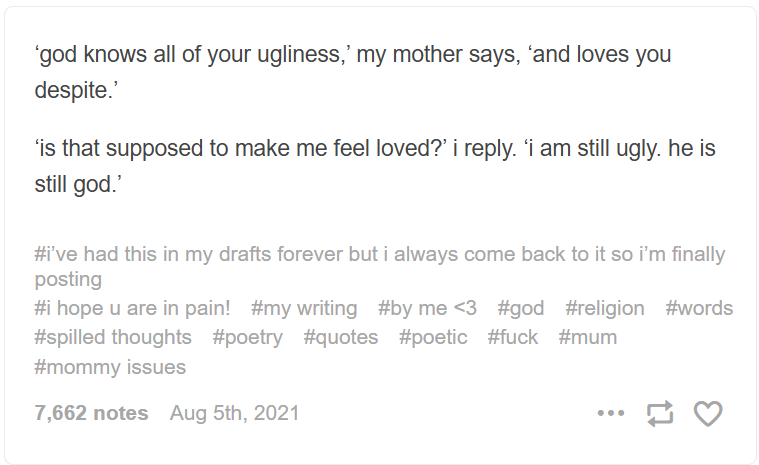
I’ve been applying to jobs like someone trying to fish with no bait. I send out resume after resume like folded notes in class, hoping someone reads them and scribbles back. Nothing. Ghost town. Radio silence. The job market is a rigged roulette table dressed up as meritocracy. I keep spinning the wheel, pretending the house doesn’t always win. And somewhere, men in glass towers still sell optimism like stock tips. They say “just pivot” like it’s a dance move, like it’s not my rent, my visa, my body on the line. There are people out there who call this a ‘skills gap,’ as if the system didn’t design the gap to be unbridgeable unless you’re born already standing on the other side. I don’t know if it’s me or the universe doing that thing again where it forgets I exist for a while. June came with its claws: PMS waited until the last minute, then pulled me under like a riptide. I nearly slipped back into the old skin: the one that lives inside a mattress, stares at the ceiling for 17 hours straight, and dreams about choking on bedsheets. I didn’t. Not entirely. But I could hear it. That beast in my mind, all teeth and whispers, even in sleep. Especially in sleep. It doesn’t growl. It doesn’t chase. It just sits. Patient. Like it knows I’ll come crawling back when the motivation runs out. It sharpens its claws on my confidence, folds my ambition into tiny paper cuts. It doesn't scream... it hums. A lullaby of all the things I’ll never be.
I’m crawling back up. Slowly. With elbows scraped and some dignity left in a jar somewhere.
I’ve also been circling around this prompt from ismatu.gwendolyn like a crow watching a carcass it’s not ready to pick apart.
(1) What is truth? [give it one sentence]
(2) Who or what do you trust to tell you what’s true about your greater world?
(3) What do your trusted sources tell you about
what is true at this particular moment?
(4) What is the narrative of truth from sources outside of those you trust?
So here goes, finally, some truth. Truth is a blade... clean, merciless, and incapable of affection.
I have tried living with it. I have tried making sense of being cut by it while it drew blood in my own life. While it unspooled a memory. While it did not save me. While it humiliated me. When someone told me the “truth” and it didn’t set me free, it just left me raw and exposed. I have tried writing that. Let truth walk in, not as a concept, but as a character. Maybe she wore stilettos. Maybe she smelled like smoke. Maybe she said my name in a voice I hated. But I could not. Because truth doesn’t arrive gently. She drags her heels on the tile, knocks once, then bursts in. She doesn’t sit. She paces. She tells you the thing you already feared and says it with no ceremony. She leaves the door open when she goes. That’s what makes her unbearable, she doesn’t care what’s left in her wake.
I trust books more than people. I trust strange poets and angry women with smudged eyeliner who say things out loud even when their hands shake. I trust people who admit they’re guessing. And I trust silence, sometimes, because it doesn’t pretend to be wise. The ghosts and saints in the bathroom stalls, in late-night forum threads, in a moment where I felt saved by someone else's unapologetic rage. With no names or gloriously unnamed, just outlined against neon lights. There was a woman once in a public library bathroom, her eyeliner looked like she'd cried it on purpose. She told me the thing I’d been afraid to name. Not to be kind, but because she needed someone to hear it too. She smelled like peppermint and gasoline. I remember thinking she was what prayer must look like if God were ever truly tired.
But what about the truth I feel about myself? The kind I can’t intellectualize or explain away. The most truth I feel about myself lives in a song—one that reminds me of a dark, windy evening. I was 13. Or 14? There had been a flood. Or was it a cyclone? I was lying on the floor. There was no electricity. All the windows were open. Everything smelled like damp stone and wet grief. A boy thought I was someone else. Another kept ignoring me for exactly who I was. I didn’t speak. Not out loud. But I still feel like I’ve been speaking from that floor ever since. Every time the wind picks up, I hear it again... the part of me that learned how to disappear without going anywhere.
And I’m not 13 or 14 anymore. The twenties have slipped halfway through my hands like wet clay, and I still haven’t figured out what shape I’m supposed to be. I locked the bedroom door some years ago and haven’t really left. Not in the ways that matter. Not in the ways that stay. And I fear... god, I fear... that I’ll never be able to. That the beast in my mind will outlive every plan, every dream, every miracle I try to make from this damage. That all my glittering fantasies, my imaginations of getting big, of becoming someone will be eaten alive by that quiet, cunning thing that lives inside me and only opens its eyes when I’m trying to sleep. It will mock me forever. Flick me hard enough to wet my eyes but never hard enough to scream. It will make me vomit out my spineless courage, laugh while I try to clean it up. It will hold up all my waste: my half-finished poems, my deleted applications, my never-sent messages, and ask, “Was this it? Is this what you were going to become?” I worry sometimes that I am not a survivor. Just a soft, slow implosion in progress. That I’ll never make anything out of this damage. Just with it. That I’ll keep stitching wreckage into art and calling it healing.
Maybe it was born from centuries of hush. Maybe the beast is colonial hangover and generational anxiety and unpaid therapy bills wrapped in a shawl and called strength. The beast with ancestors lacerations in the existing skin where the blood of inner torment leaks out and feeds the systems that taught silence to women, especially brown ones.
Diane Nguyen: Because if I don't, that means that all the damage I got isn't good damage, it's just damage. I have gotten nothing out of it, and all those years I was miserable was for nothing. I could've been happy this whole time and written books about girl detectives and been cheerful and popular and had good parents, is that what you're saying? What was it all for? [Source]
I too once started writing a short story about a girl who never spoke, but could taste lies on her tongue. I stopped midway through because I got scared it was too strange, too soft, too much like me. It still sits in my drafts, unnamed. I don’t open it. I pretend it ended where I left it. Like it chose silence over rejection. And then, one night, I stumbled across a reel. A man said, quietly “I guess I’ll talk about my biggest regret in life… I threw away a museum.” And it hit me so hard I almost forgot how to breathe. Because I knew. I knew what he meant. That this unfinished life I keep trying to build and rebuild isn’t just a mess, it's a museum. A museum of almosts. A museum of drafts and detours and detachment. And one day, I might walk through it, alone, and realize I didn’t lose it to fate or bad luck. I lost it to fear. I curated a gallery of empty frames because I was too scared to hang the damn art. Too scared to finish. Too scared to start. Too scared to be bad. Too scared to be seen. And now I wonder if that’s the legacy of this beast inside me: not just pain, but incompleteness. A life made of corridors that never open into rooms. And the haunting knowledge that I was the one who locked the doors. That one day, I will look back and realize I preserved my life in the waiting room more than I lived it in the present. And one day, people with full lives; messy, radiant, loud, living lives; will meander past. They’ll stroll by this museum of emptiness without pausing. Without noticing the walls once trembled from the weight of unsaid things. It will become so benign, so forgettable, so dust-covered and quiet, it will be like it never even meant to exist. Not a tragedy. Not a warning. Just an absence so ordinary it blends into the skyline. Maybe that’s the cruelest kind of erasure, the kind that doesn’t even need effort. Maybe that’s what regret is: a museum without visitors.
The world doesn’t mourn what doesn’t become profitable. It forgets slow creators. It buries us under headlines of unicorns and 30-under-30s until we start thinking our quiet is a crime. Maybe truth was never supposed to be healing. Maybe it was meant to be dangerous. That’s why they fear ours because it doesn’t sell anything. It just stands there, wounded and whole.
Anyway. These trusted sources tell me that everything is falling apart, not in a dramatic apocalypse way, but in the slow, invisible kind of rot, the kind that happens behind walls before a house caves in. The foundation’s cracked because the blueprint was never meant to shelter us. It was built by men who assumed someone else would scrub the floors, bear the weight, serve the tea, stay quiet. And here we are... exhausted, holding up ceilings that were never meant to hold us. The house. The rot. The inevitable collapse. My house still stands, and I, in it. But the wallpaper peels. It smells wrong in the mornings, like something sweet has died in the vents. I keep opening windows and pretending fresh air is enough. The landlord says it’s just age. I don’t have the energy to argue that it’s grief.
They say we’re all pretending not to notice how deeply exhausted we are. They say we’re told to be resilient, as if we’re not already bruised from how long we’ve had to hold everything together. Outside of this circle of trust, the narrative is slick and manicured. The world is fine. Growth is inevitable. Everyone just needs to hustle harder. Trust the system. Everything will be okay. It’s a lie wrapped in QR codes and hashtags and mental health webinars hosted by the same corporations that break you down. I once watched a CEO in a turtleneck talk about work-life balance while sipping a turmeric latte named after a Sanskrit word he couldn’t pronounce. That’s when I knew: they’re not trying to fix us. They’re trying to pacify us. I know better now. The truth rarely comes in bold fonts or corporate slides. “Self-care isn’t selfish,” says the carousel post by a billion-dollar wellness brand. Meanwhile, my non-profit pays only 50% of my salary, no insurance, nothing to cover therapy. The only affordable ‘care’ is staying very, very still and hoping my feelings expire quietly. They weaponize wellness, market our survival instincts back to us with pastel fonts and lavender-scented lies. I don’t need a mindfulness app. I need rent control. I need healthcare. I need for rest not to be treated as a privilege or an act of rebellion. I need systems that don’t treat burnout like a personal failure.
Capitalism doesn’t break you in one clean blow. It erodes you with coffee-stained teeth, dry eyes, polite smiles in Zoom meetings, pretending your value isn’t shrinking by the hour. Maybe that’s why they want us too tired to write. Maybe that’s why they flood the world with noise, so we forget how radical silence can be when it’s filled with our own words. They don't want our grief documented. They want it internalized, made polite, made private. But I’ve stopped being polite about it.
It slinks in during the third hour of insomnia. It tastes like metal and sounds like something breaking underwater. I don’t always want it. But I want to be someone who can carry it, even when it’s heavy. Even when I’d rather drop it and run. Maybe that’s what writing this is. Lugging the truth to the page, letting it sit there and stink up the room. Letting it breathe. Letting it be. This writing is a physical labor. Grotesque. Viscous. Cathartic. Writing is not (just) a performance, it’s a purging for me. Letting the words bleed. Writing it feels like butchering something that once lived inside me, pulling sinew and cartilage out through my throat, hoping the mess makes sense on paper. Truth has a smell. A sound. An aftertaste. Truth stinks like copper and mold. It clings to the curtains. I can’t always breathe after I write, but I can finally sleep.
They told me rage was unbecoming. So I stitched it into essays. Let it leak through margins. I wrote like someone trying to dislocate a bone on purpose just to prove it still existed. Like I was testing if my pain still made a sound. My sadness kept waxing. My truth kept howling. Always nearly full, always on the verge of spilling. And somehow, I kept writing: half-mad, half-moon, never empty. And maybe that’s all I’ll leave behind. Not a masterpiece. Just a trail of blood on the page that says: I was here. I didn't quit. I wrote it anyway. Maybe God didn’t show up because She was too busy writing Her own diary entry. Maybe She’s tired too. Maybe She’s in a room somewhere, sobbing over us like unfinished drafts. Or maybe not. Maybe She’s the one whispering: write it anyway. I am kidding, there is no God. Or maybe truth is the only god left: feral, ungoverned, hiding in backrooms and diaries, still refusing to kneel. Sounds familiar, doesn’t it? That’s what humans do. We find something unmanageable; love, fire, death, rain; and we crown it. We build temples to what we can’t tame. We call it divine when it doesn’t listen back. We put it on a pedestal and weaponize it against anyone who dares to question. Maybe that’s what we’ll do to truth too. Put it in a museum. Etch it on stone. Forget how much it once hurt to hold.
- Oizys.